The automotive landscape in 2026 is defined by unprecedented technological advancements, but it is also characterized by record-high insurance premiums. Driven by macroeconomic inflation, the soaring costs of repairing advanced vehicle sensors, and an increase in severe weather claims, many drivers are feeling a deep sense of frustration when their annual renewal notices arrive in the mail.
However, there is a powerful defense against rising rates that most drivers severely underutilize: car insurance discounts.
The good news is that almost every major insurance carrier offers a vast, diverse portfolio of premium reductions. The bad news? The vast majority of these discounts are not applied automatically. Insurance companies are businesses; they will not voluntarily lower your bill unless you prove you meet the criteria and actively demand the discount.
Understanding exactly how these discounts work, what actuarial behaviors trigger them, and how to aggressively stack them is the secret to cutting your insurance bill down to size. In some optimal scenarios, a strategic driver can combine multiple discounts to reduce their total car insurance costs by an astonishing 20% to 40%.
As a senior insurance content expert, I have developed this comprehensive, 3,000-word master guide to demystify car insurance discounts. We will explore the most valuable discounts available on the open market in 2026, explain the hidden actuarial logic behind why insurers offer them, and provide step-by-step instructions on how to force your carrier to apply them to your policy today.
Table of Contents
Why Do Car Insurance Discounts Even Exist?
Before diving into the specific discounts, it is crucial to understand the psychology and mathematics of the insurance industry. Insurance pricing is governed entirely by risk probability and operational efficiency.
Insurers do not offer discounts out of generosity. They offer them when they identify a specific data point that mathematically proves you are less likely to cost them money.
Car insurance discounts serve three primary corporate goals for the insurer:
- Risk Mitigation: Rewarding behaviors that statistically reduce the likelihood of a severe accident (e.g., taking a defensive driving course).
- Customer Retention: Creating “sticky” customers who are less likely to leave for a competitor (e.g., bundling home and auto insurance).
- Operational Efficiency: Reducing the insurer’s internal administrative overhead (e.g., paperless billing and paying in full).
When you align your profile with these three goals, you unlock massive financial savings without ever having to reduce your vital coverage limits.
Category 1: Driver Behavior and History Discounts
The most lucrative discounts in the industry are based on your personal performance behind the wheel. Insurers fiercely compete to acquire and retain the safest drivers on the road.
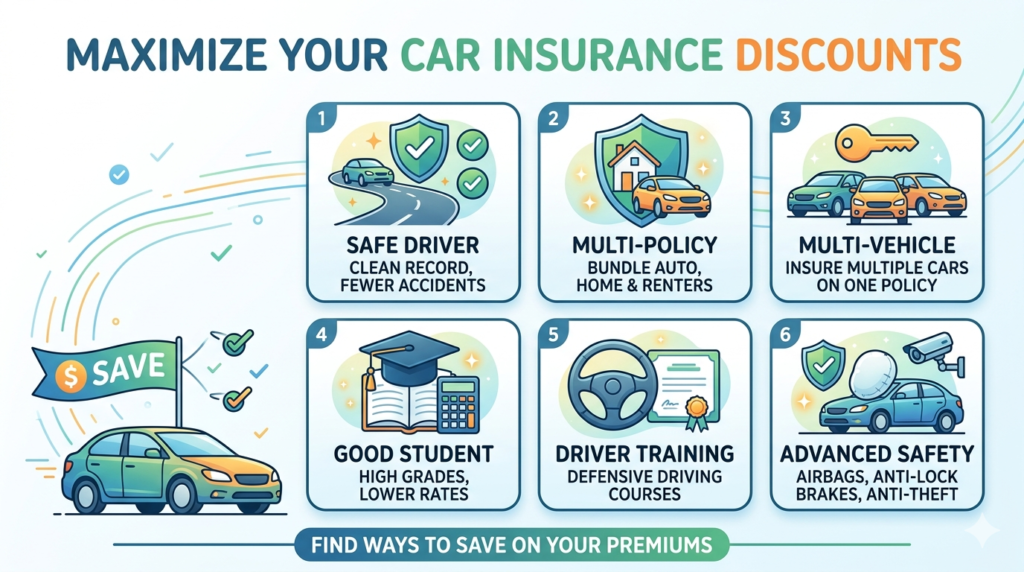
1. The Safe Driver (Claims-Free) Discount
This is the holy grail of car insurance discounts and typically offers the largest single percentage drop in your premium.
- How It Works: Insurers reward drivers who maintain a pristine driving record over a continuous period. To qualify, you generally must have zero at-fault accidents, zero moving violations (speeding tickets, reckless driving), and zero comprehensive claims on your record for a minimum of 3 to 5 consecutive years.
- The Actuarial Reason: Past behavior is the single most accurate predictor of future risk. A driver who has navigated the roads safely for 60 months is statistically highly unlikely to file a massive liability claim tomorrow.
- Potential Savings: 10% to 30% off your base premium.
- Expert Pro-Tip: Do not ruin your claims-free status over minor cosmetic damage. If you back into a mailbox and cause $800 in damage to your bumper, and your deductible is $500, do not file a claim for the $300 payout. Doing so will reset your “claims-free” clock to zero, and the resulting loss of your Safe Driver discount will cost you thousands of dollars over the next five years.
2. Telematics and Usage-Based Insurance (UBI)
In 2026, telematics is no longer a niche program; it is the industry standard for aggressive rate reduction.
- How It Works: You agree to let the insurance company monitor your actual, real-time driving habits. This is typically done either through a smartphone app that uses your phone’s internal gyroscope and GPS, or via a small OBD-II device plugged directly into your car’s diagnostic port.
- What is Measured: The algorithm tracks your speed, hard braking incidents, rapid acceleration, sharp cornering, phone screen usage while the vehicle is in motion, and the time of day you drive (driving between midnight and 4:00 AM is heavily penalized).
- The Actuarial Reason: Traditional insurance bases your rate on demographic assumptions (e.g., “All 25-year-old males are reckless”). Telematics bases your rate on your actual behavior. It removes the guesswork for the underwriter.
- Potential Savings: Up to 30% or more for the safest drivers.
- Expert Pro-Tip: Most companies offer an immediate 5% to 10% “participation discount” just for signing up. However, be warned: while many programs promise they will “only lower” your rates, some aggressive carriers in 2026 will actually raise your rates at renewal if the telematics data proves you are a reckless, high-risk driver.
3. The Defensive Driving Course Discount
You don’t have to wait years to prove you are a safe driver; you can take proactive educational steps today.
- How It Works: You enroll in and complete a state-approved defensive driving or accident prevention course. Today, almost all of these can be completed entirely online in a few hours.
- The Actuarial Reason: Educated drivers who are refreshed on the rules of the road, modern right-of-way laws, and hazard-avoidance techniques are statistically involved in fewer collisions.
- Potential Savings: 5% to 15%, typically applied to your premium for three consecutive years before you need to retake the course.
- Expert Pro-Tip: In many states (like New York with its PIRP program), insurance companies are legally mandated by state law to give you a mandatory 10% discount for three years upon completion of a certified course. This is not optional for the insurer; it is your legal right.
Category 2: Policy Structuring and Loyalty Discounts
How you design your insurance portfolio and how you pay your bills heavily dictates the final price of your coverage. Insurers love efficiency and volume.
4. The Multi-Policy (Bundling) Discount
If you only take away one piece of advice from this guide, let it be this: never buy your insurance policies from different companies if you can avoid it.
- How It Works: You purchase multiple, distinct insurance products from the exact same carrier. The most common combination is Auto Insurance + Homeowners Insurance. However, you can also bundle Auto + Renters, Auto + Condo, or Auto + Life Insurance.
- The Actuarial Reason: This is about “Account Density.” When an insurer holds both your home and your car policies, your “friction to leave” becomes very high. You are highly unlikely to go through the hassle of migrating two massive policies to a competitor. Insurers reward this intense loyalty and guaranteed retention with massive price cuts.
- Potential Savings: 10% to 25% across both policies.
- Expert Pro-Tip: Even if you do not own a home, bundling a cheap $15/month Renters Insurance policy with your Auto Insurance often yields an auto discount that is larger than the actual cost of the Renters policy itself. It essentially pays for itself.
5. The Multi-Vehicle Discount
If you have more than one car in your driveway, they should all be on the same declarations page.
- How It Works: You insure two or more vehicles under a single primary auto policy, rather than having separate policies for each car. To qualify, the vehicles generally must be parked at the same primary residence (garaging address).
- The Actuarial Reason: Economies of scale. It costs the insurance company less in administrative overhead to manage one massive policy with two cars than to manage two separate policies. Furthermore, one driver cannot physically drive two cars at the exact same time, lowering the simultaneous risk exposure on the road.
- Potential Savings: 10% to 20%.
6. The Pay-in-Full Discount
Stop treating your auto insurance like a monthly subscription service.
- How It Works: Instead of paying your premium in 6 or 12 monthly installments, you pay the entire 6-month or 12-month premium upfront in one single lump-sum payment via credit card or electronic funds transfer (EFT).
- The Actuarial Reason: When you pay monthly, the insurer assumes a massive financial risk: the risk of a “lapse in coverage” due to a bounced check or an expired credit card. They also incur monthly credit card processing fees and billing administration costs. By paying in full, you guarantee them immediate capital to invest and completely eliminate their billing overhead. They pass those savings back to you.
- Potential Savings: 5% to 10%.
7. Paperless Billing and Auto-Pay Discounts
If you absolutely must pay monthly, you can still squeeze out an administrative discount.
- How It Works: You agree to receive all your policy documents, ID cards, and billing notices via email or a secure mobile app, and you authorize the insurer to automatically draft your monthly payment from a checking account (EFT).
- The Actuarial Reason: The insurer saves millions of dollars globally on postage, paper, printing costs, and manual check-processing labor.
- Potential Savings: Typically a flat fee reduction (e.g., $30 to $50 off your term premium) or a 2% to 4% discount.
Category 3: Vehicle Specifications and Usage Discounts
The physical machine you drive, and exactly how often you drive it, are massive variables in the underwriting algorithm.
8. The Low Mileage (Pleasure Use) Discount
The shift toward remote and hybrid work models in the 2020s has made this discount more relevant than ever in 2026.
- How It Works: Insurers establish “annual mileage tiers.” If you drive less than the standard national average (usually around 12,000 miles per year), you qualify for a discount. The lower your tier (e.g., under 10,000 miles, under 7,500 miles, or under 5,000 miles), the steeper the discount.
- The Actuarial Reason: It is pure mathematics. A car sitting safely in a locked garage 22 hours a day cannot rear-end another vehicle on the highway. Less time on the road equals less exposure to statistical risk.
- Potential Savings: 5% to 15%.
- Expert Pro-Tip: Do not guess your mileage. If you transitioned to a remote job and stopped a daily 30-mile commute, call your agent immediately and request a change in your “Vehicle Usage” from “Commuter” to “Pleasure Use.” You may be required to submit a photo of your odometer or provide a service station receipt to verify the low mileage.
9. Advanced Vehicle Safety Features Discount
Insurers will subsidize the cost of your car’s modern technology because it saves them money in liability payouts.
- How It Works: Your vehicle is equipped with factory-installed safety mechanisms designed to prevent accidents or mitigate occupant injury.
- What Qualifies: Anti-lock braking systems (ABS), electronic stability control, multiple advanced airbag systems, daytime running lights, blind-spot monitoring, and automatic emergency braking (AEB).
- The Actuarial Reason: An automatic emergency braking system might stop a high-speed rear-end collision, turning a potential $50,000 bodily injury lawsuit into a minor $2,000 bumper repair. The insurer rewards the hardware that mitigates their financial liability.
- Potential Savings: 5% to 15% (Usually applied specifically to the Medical Payments or Personal Injury Protection portions of your premium).
- Expert Pro-Tip: Most modern insurers automatically apply these discounts by reading your 17-digit Vehicle Identification Number (VIN), which tells the algorithm exactly what factory features the car possesses.
10. Anti-Theft Device Discount
Protecting your car from criminals protects the insurance company’s comprehensive coverage reserves.
- How It Works: Your car is equipped with systems designed to deter theft or aid in the rapid recovery of a stolen vehicle.
- Passive vs. Active Systems: A standard car alarm that merely honks the horn is an “active” system and yields a very small discount. A “passive” engine immobilizer (a microchip in the key that prevents the engine from starting without it) yields a larger discount. GPS tracking and recovery systems (like LoJack or advanced OEM telematics) yield the highest discounts.
- Potential Savings: 5% to 20% (Applied specifically to the Comprehensive portion of your premium).
Category 4: Demographics, Affiliations, and Hidden Discounts
Insurance companies utilize massive demographic databases to identify specific cohorts of people who, statistically, are incredibly safe and responsible.
11. The Good Student Discount
Adding a teenage driver to your policy is notoriously expensive, but academic excellence provides a powerful financial shield.
- How It Works: Unmarried, full-time students (usually under the age of 24 or 25) who maintain high academic marks qualify for a massive rate reduction.
- The Requirements: The student must typically maintain a “B” average (a 3.0 GPA), rank in the top 20% of their class, or achieve standardized test scores in the upper percentiles.
- The Actuarial Reason: Actuaries have proven a direct, undeniable correlation between academic responsibility and driving responsibility. Teenagers who are dedicated to their studies, follow academic rules, and avoid truancy are statistically far less likely to engage in reckless driving, street racing, or driving under the influence.
- Potential Savings: 10% to 25%.
- Expert Pro-Tip: You will need to provide proof. When your policy is up for renewal, be prepared to submit the student’s most recent official report card or university transcript to maintain the discount.
12. Student Away at School Discount
If your child goes off to college, do not keep paying full price for their empty seat in your car.
- How It Works: If an insured young driver attends a university that is more than 100 miles away from your primary residence, and they do not take a vehicle with them to campus, you qualify for a steep discount.
- The Actuarial Reason: The high-risk youthful driver is essentially removed from the road for 8 to 9 months of the year, only driving the family car during winter and summer holidays.
- Potential Savings: 10% to 30% off the youthful driver’s specific premium allocation.
13. Affinity, Occupational, and Group Discounts
Your job title or your university degree could be worth hundreds of dollars in hidden savings.
- How It Works: Insurers partner with thousands of external organizations to offer group-rate discounts.
- Who Qualifies:
- Alumni Associations: Graduating from a specific major university often unlocks a 5% discount.
- Occupations: Statistical data shows that certain professions are incredibly risk-averse. Engineers, scientists, teachers, nurses, and certified public accountants (CPAs) are frequently offered occupational discounts.
- Memberships: Being a member of a credit union, a specific wholesale club (like Costco or Sam’s Club), or a professional fraternity.
- Military and Federal Employees: Active-duty military, veterans, and federal government employees are almost universally offered specialized, deeply discounted rate structures (e.g., through companies like USAA or Geico).
- Potential Savings: 5% to 15%.
14. The “Early Quote” (Advance Purchase) Discount
Procrastination costs you money in the insurance world.
- How It Works: You receive a discount for shopping for and locking in a new insurance policy well before your current policy expires. To qualify, you usually need to sign the new contract 7 to 14 days before the effective start date.
- The Actuarial Reason: People who plan ahead, manage their finances meticulously, and don’t wait until the day their policy expires to shop for coverage are mathematically proven to be highly responsible individuals. Responsible planners file fewer claims than disorganized procrastinators.
- Potential Savings: 3% to 10%.
The Master Strategy: How to “Stack” Discounts for Maximum Leverage
Knowing the discounts exist is step one. Step two is executing a strategic “stacking” maneuver to compound your savings.
However, you must be aware of the Maximum Discount Cap. Insurance companies will let you stack (combine) discounts, but almost all carriers have a hard ceiling in their algorithm. Even if you qualify for 10 different discounts that add up to 60%, the insurer’s underwriting rules will usually cap your total allowable discount at around 30% to 40% of the base premium.
The Ideal Stacking Scenario for a Family:
- Bundle the Home and Auto policies (-20%).
- Ensure both spouses have clean driving records for the Safe Driver discount (-15%).
- Set up Auto-Pay and Paperless billing (-3%).
- Submit the 17-year-old’s report card for the Good Student discount (-15% off the teen’s rate).
- Opt the entire family into a Telematics tracking program (-10% initial discount).
By orchestrating this exact stack, a family facing a potentially crippling $4,000 annual premium can aggressively force the algorithm to apply maximum downward pressure, hitting the carrier’s absolute discount ceiling and saving thousands of dollars.
4 Common Mistakes That Destroy Your Discount Eligibility
Many drivers unknowingly forfeit their hard-earned discounts due to simple administrative negligence. Avoid these critical errors:
- Falling for the Loyalty Trap: Believing that staying with the same company for 10 years guarantees you the lowest rate is a massive financial fallacy. While “loyalty discounts” exist, they are often a smokescreen for “Price Optimization” (where insurers slowly raise your base rate year after year because they know you are too loyal to leave). The best discount is often the “New Customer” discount at a competing firm.
- Failing to Report Life Changes: Did you retire? Did you start working from home? Did you get married? All of these life events trigger massive risk reductions in the algorithm. If you do not proactively call your agent to update your profile, you will continue paying the higher rate of a single, daily commuter.
- Assuming Automation: Never assume the insurance company knows you deserve a discount. They will read your VIN for safety features, but they do not know if your teenager made the Honor Roll, or if you joined a credit union, or if you took a defensive driving course unless you explicitly provide the documentation.
- Chasing Discounts Instead of Value: A 40% discount on a policy that has a grossly inflated base rate is still a terrible deal. Do not be blinded by the word “discount.” A company offering zero discounts but a base rate of $1,000 is infinitely better than a company offering a 30% discount on a base rate of $2,000. Focus on the final bottom-line dollar amount.
Frequently Asked Questions (FAQ)
Do all insurance carriers offer the exact same car insurance discounts?
No. While there are industry standards (like Multi-Policy and Safe Driver), the specific availability, rules, and percentage amounts vary wildly by carrier and by state. State Departments of Insurance heavily regulate what discounts can legally be offered within their borders.
Do discounts reduce my actual insurance coverage limits?
Absolutely not. This is a common misconception. Applying a discount reduces the financial cost of the premium you pay; it does not in any way reduce the amount of protection or the liability limits the insurance company is legally obligated to provide in the event of an accident.
Can I negotiate my car insurance rate like I would at a car dealership?
No. Auto insurance rates are strictly regulated mathematical formulas filed with and approved by the state government. An insurance agent cannot simply “knock $50 off” your premium to close a deal. The only legal way an agent can lower your price is by finding and applying verified, state-approved discounts to your profile, or by lowering your coverage limits (which increases your risk).
How often should I audit my policy for new car insurance discounts?
You should conduct a comprehensive review of your policy at least once every 12 months, ideally about 30 days before your annual or semi-annual renewal date. You should also trigger an immediate review after any major life event: moving to a new ZIP code, buying a home, getting married, changing jobs, or a child turning 16.
Conclusion: Taking Control of Your Auto Insurance Overhead
In the highly automated, algorithm-driven insurance market of 2026, complacency is the most expensive mistake a driver can make. Car insurance discounts are not random acts of corporate generosity; they are precise financial rewards designed to incentivize low-risk behavior and streamlined administration.
By understanding the exact criteria that trigger these premium reductions, maintaining a fiercely protective stance over your driving record, and actively engaging with your carrier to ensure every eligible affiliation, safety feature, and behavioral metric is properly logged on your declarations page, you can fundamentally alter the cost of your coverage.
The ultimate key to affordable auto insurance is not simply finding the cheapest, lowest-tier policy available. The key is securing robust, high-limit protection, and then ruthlessly applying every possible discount to force that premium down to its absolute mathematical floor. Do not wait for your insurer to offer you savings—pick up the phone, demand a discount audit, and take control of your financial overhead today.
Sources
- Insurance Information Institute – Auto Insurance Discounts
- Consumer Financial Protection Bureau – Auto Insurance Guide