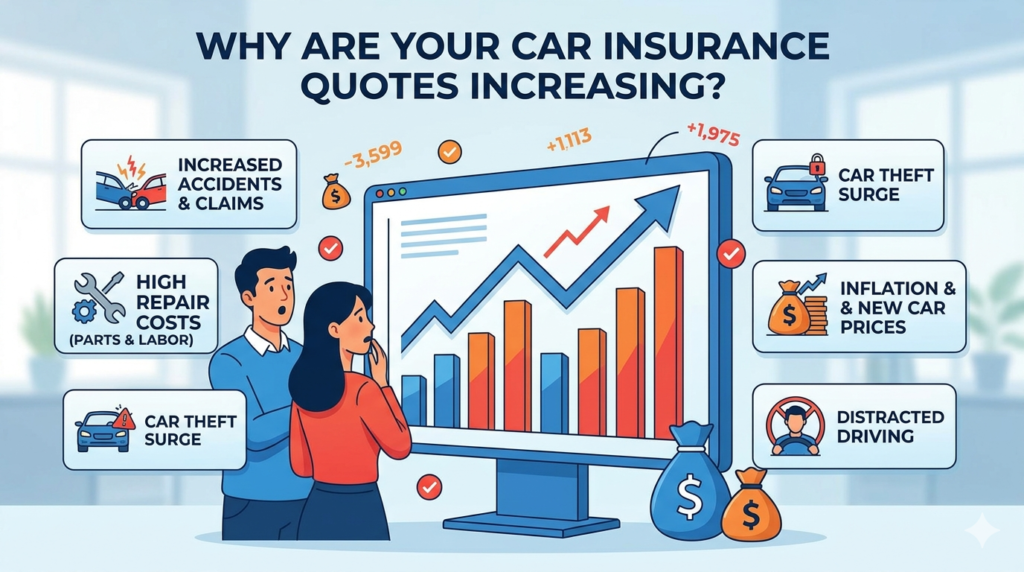
Opening your mail to find a massive price hike on your auto insurance renewal is one of the most frustrating experiences a driver can face. Many policyholders are completely blindsided when their car insurance quotes increase year after year—especially when they haven’t filed a single claim, received a speeding ticket, or changed their daily driving habits.
In 2026, rising auto insurance premiums have evolved from an occasional annoyance into a widespread, systemic financial concern. Millions of drivers are left asking the same question: “Why am I paying so much more for the exact same coverage?”
The harsh reality is that insurance pricing is influenced by a vast web of macroeconomic factors, technological shifts, and industry-wide data models that exist far beyond your personal driving record. Insurers do not just price your policy based on how safely you drive; they price it based on the cost of doing business in your specific region at this specific moment in time.
As a senior insurance analyst and content specialist, I have developed this comprehensive 2026 guide to pull back the curtain on the auto insurance industry. We will explore the exact algorithms and real-world conditions driving these price hikes. More importantly, we will outline actionable, expert-level strategies you can deploy today to outsmart the system, mitigate these increases, and lock in the affordable coverage you deserve.
Table of Contents
The Underwriting Algorithm: How Insurers View Your Policy
Before diving into the specific factors driving up costs, it is crucial to understand how an insurance underwriter views your policy.
Insurance is fundamentally a game of mathematical probability and risk transfer. When you request a car insurance quote, the provider runs your data through highly complex, proprietary algorithms. These models calculate the statistical likelihood that you will file a claim, multiplied by the projected financial severity of that claim.
When your car insurance quotes increase at renewal, it means the algorithm has detected a shift. Either the frequency of claims in your demographic has risen, or the cost to resolve those claims has inflated. Let’s break down the 10 primary culprits behind your rising premium.
1. The Technological Explosion in Vehicle Repair Costs
The single largest driver of premium increases in 2026 is the sheer cost of modern vehicle repair. We are no longer driving simple machines made of steel and glass; we are driving highly sophisticated computers on wheels.
The ADAS Dilemma: Almost all modern vehicles are equipped with Advanced Driver Assistance Systems (ADAS). This includes lane-departure warnings, automatic emergency braking, adaptive cruise control, and blind-spot monitoring. While these systems prevent accidents, they are incredibly fragile and astonishingly expensive to replace.
A decade ago, a minor fender bender might require a $300 plastic bumper replacement. Today, that same minor impact destroys ultrasonic sensors, LiDAR modules, and rearview cameras embedded in the bumper. That $300 repair quickly spirals into a $3,000 recalibration and replacement job.
The EV Factor: The rising market share of Electric Vehicles (EVs) and hybrids also inflates the global repair market. EV batteries are highly vulnerable. A bottom-out scrape that would dent the exhaust of a gas-powered car can compromise the structural integrity of an EV battery pack, resulting in a total loss designation for the entire vehicle. Furthermore, EVs require highly specialized, high-voltage certified mechanics, driving up hourly labor rates drastically.
2. The Resurgence of Accident Frequency and Severity
Despite the introduction of advanced safety technology, the roads have become statistically more dangerous in recent years, leading to a higher frequency of severe claims.
Distracted Driving: The integration of massive touchscreen infotainment centers in vehicle dashboards, combined with the ubiquitous use of smartphones, has led to a crisis of distracted driving. Accidents occurring at higher speeds because a driver failed to brake at all (due to looking at a screen) result in massive property damage and severe bodily injury claims.
The Weight and Size Arms Race: The consumer preference for massive SUVs and heavy electric vehicles means that the average weight of a vehicle on the road has increased significantly. When a 6,000-pound electric SUV collides with a standard 3,000-pound sedan, the kinetic energy transfer is devastating. These heavier vehicles cause more structural damage and worse injuries in multi-car pileups, forcing insurers to pay out maximum liability limits more frequently.
3. Macro-Economic Inflationary Pressures
Inflation is a silent tax that affects every corner of the global economy, and the auto insurance sector is particularly vulnerable to its compounding effects.
When an insurer collects your premium today, they are essentially promising to pay for a repair that might happen 11 months from now. If inflation is running hot, the cost of that future repair will be higher than the underwriter initially calculated. To protect their cash reserves, insurers preemptively raise car insurance quotes across the board.
Key Inflationary Pain Points:
- Auto Parts Supply Chain: The cost of OEM (Original Equipment Manufacturer) replacement parts has surged due to global supply chain constraints and raw material costs.
- Labor Shortages: There is a severe shortage of qualified auto body technicians and mechanics. To attract talent, repair shops must pay higher wages, a cost that is passed directly to the insurance companies via higher hourly labor claims.
- Used Car Valuations: When a car is totaled, the insurer must pay you the Actual Cash Value (ACV) of the vehicle. Because the used car market has seen massive price inflations, insurers are writing significantly larger checks for totaled vehicles than they were five years ago.
4. Climate Volatility and Catastrophic Weather Claims
Your car insurance policy contains a component called “Comprehensive Coverage,” which protects your vehicle from “Acts of God”—events completely out of your control, such as theft, vandalism, and extreme weather.
In 2026, climate volatility is a primary reason comprehensive car insurance quotes increase. Insurers are dealing with an unprecedented volume of localized catastrophic weather events:
- Severe Hailstorms: A severe hailstorm passing over a highly populated suburban area can instantly total thousands of parked cars in a matter of minutes, resulting in hundreds of millions of dollars in localized losses.
- Flash Flooding: Urban flooding destroys engines and electrical systems, resulting in immediate total-loss claims.
- Wildfires and Hurricanes: Regional disasters force insurers to pay out massive clusters of comprehensive claims simultaneously.
If you live in a ZIP code that has recently been reclassified as a higher-risk zone for severe weather, your comprehensive premium will spike, regardless of your perfect driving record.
5. The Spiraling Cost of Medical Care and Litigation
Car insurance doesn’t just pay to fix bent metal; it pays to heal broken bodies. The liability portion of your policy (Bodily Injury Liability) and your personal medical coverage (Personal Injury Protection or MedPay) are heavily impacted by the broader healthcare system.
Medical Inflation: The cost of emergency room visits, ambulance rides, MRIs, and long-term physical therapy continues to outpace standard economic inflation. As the cost of treating accident victims rises, auto insurers must increase premiums to ensure they have the capital to cover these multi-million-dollar medical payouts.
Social Inflation and Nuclear Verdicts: The insurance industry is currently battling a phenomenon known as “social inflation.” Juries are increasingly awarding massive, multi-million-dollar settlements (often called “nuclear verdicts”) to accident victims, heavily influenced by aggressive personal injury attorney advertising. To insulate themselves against these massive legal payouts and attorney defense fees, insurers spread the cost across the entire customer base via higher premiums.
6. Algorithmic Shifts in Your Personal Risk Profile
Sometimes, car insurance quotes increase because a specific variable in your personal demographic profile changed without you realizing it triggered the algorithm.
- Moving to a New ZIP Code: Insurance is hyper-local. Moving just two miles down the road can push you into a new ZIP code with higher rates of vehicle theft, more congested intersections, or a higher volume of uninsured drivers.
- Changes in Credit-Based Insurance Scores: In states where it is legally permitted, insurers use your credit history to generate an “insurance score.” Actuarial data shows that individuals with lower credit scores are statistically more likely to file claims. If your credit score dropped due to high credit card utilization or a missed payment, your renewal rate will likely increase.
- Aging into a New Bracket: While rates generally drop as you enter your 30s and 40s, they begin to rise again once you enter your senior years. Drivers over the age of 70 often see gradual premium increases due to the statistical likelihood of age-related driving impairments.
- Commute Changes: If you changed jobs and your daily commute increased from 5 miles to 25 miles each way, your exposure to road risk has mathematically quintupled, resulting in a higher rate.
7. The Reality of Risk Pooling and Shared Industry Losses
One of the hardest concepts for safe drivers to accept is that they are financially tethered to bad drivers. Insurance operates on the principle of “Risk Pooling.”
Your premiums do not go into an individual savings account with your name on it. Your premiums are pooled into a massive communal fund with thousands of other drivers in your state. When someone in that pool causes a catastrophic six-car pileup, the money to pay for those damages comes out of the collective pool.
If an insurance company experiences a year of heavy underwriting losses—meaning they paid out more in claims than they collected in premiums—they must file for a “rate revision” with the state’s Department of Insurance. Once approved, they will apply a blanket rate increase to everyone in the pool to replenish their financial reserves. You are essentially paying the tax for the reckless driving of your geographic neighbors.
8. Hidden Coverage Adjustments and Diminishing Discounts
Often, a premium increase is not a base rate hike, but rather the expiration of a discount you forgot you had.
- The “New Customer” Teaser Rate: Many insurers offer steep discounts (often up to 20%) to win your business in year one. At your first or second renewal, this “new customer discount” quietly falls off the policy, resulting in a sudden price jump.
- Good Student/Telematics Drop-offs: If your child’s GPA dropped below a “B” average, or if they graduated, the Good Student discount vanishes. Similarly, if you completed a 90-day telematics tracking program (using an app to track your driving) and your driving data was deemed “average” rather than “excellent,” the initial participation discount may be removed.
- Speeding Tickets Catching Up: Moving violations and traffic tickets do not always hit your policy immediately. An insurer may not run your Motor Vehicle Report (MVR) until your second or third renewal. A ticket you got 18 months ago might just now be surfacing on the underwriter’s desk, triggering a surcharge.
9. Surges in Targeted Vehicle Theft Rates
The make and model of the vehicle you drive plays a massive role in your premium. Insurers track national and regional theft data meticulously.
If the specific car you drive suddenly becomes a viral target for organized theft rings (as seen in recent years with specific models lacking electronic immobilizers), your comprehensive coverage costs will skyrocket.
Additionally, the theft of specific high-value components—such as catalytic converters, which contain precious metals like rhodium and palladium—has become an epidemic. Because a stolen catalytic converter often results in a $2,500 comprehensive claim, insurers aggressively raise rates on the vehicle models most frequently targeted by these thieves.
10. The Infamous “Loyalty Penalty” (Price Optimization)
Perhaps the most controversial reason car insurance quotes increase is a Big Data practice known as “Price Optimization,” commonly referred to by consumer advocates as the Loyalty Penalty.
Insurance companies use incredibly sophisticated data analytics to determine your “price elasticity”—meaning they calculate exactly how much they can raise your premium before you will take the time and effort to cancel your policy and shop for a new provider.
If their algorithms determine that you are a passive consumer who has automatically renewed your policy for the last five years without calling to complain, they will slowly and incrementally raise your base rate by 3% to 7% every year. They know that the friction of shopping for new insurance is high, and they exploit your loyalty for pure profit. The longer you stay with one company, the higher the probability that you are severely overpaying compared to a brand-new customer with the exact same driving profile.
Strategic Interventions: How to Fight Back and Lower Your Quotes
Understanding why your rates are increasing is only half the battle. To protect your wallet in 2026, you must take proactive, aggressive steps to optimize your policy. Do not simply accept the renewal notice as a fixed cost. Implement these expert strategies immediately:
1. Annually Shop the Open Market (Beat the Loyalty Penalty)
The single most effective way to lower your premium is to compare auto insurance quotes online every 12 months. Treat your auto insurance like a 12-month lease, not a lifetime marriage. By consistently rotating carriers every few years, you continually capture “new customer” acquisition discounts and defeat the price optimization algorithms.
2. Radically Increase Your Deductibles
The deductible is the amount you pay out-of-pocket before the insurance company cuts a check. If you currently carry a low $250 or $500 deductible, you are paying a massive premium for the privilege. If you have an emergency fund, raise your comprehensive and collision deductibles to $1,000 or even $2,500. This signals to the underwriter that you will not file petty claims for minor scratches, and they will dramatically slash your monthly premium in response.
3. Embrace Telematics (Usage-Based Insurance)
If you are a genuinely safe driver, prove it. Opt into your insurer’s telematics program. You will download an app that tracks your braking, acceleration, cornering speed, and late-night driving habits. If you drive smoothly and avoid high-risk driving hours (midnight to 4 AM), you can permanently slash your premium by up to 30%.
4. Bundle Policies Aggressively
The “Multi-Line Discount” is the holy grail of insurance savings. If you currently have your auto insurance with Company A and your homeowner’s (or renter’s) insurance with Company B, you are losing money. Moving both policies under one roof makes you a highly profitable, “sticky” customer for the insurer, and they will routinely reward you with a 15% to 25% discount across the board.
5. Drop Unnecessary Coverage on Depreciating Assets
If you are driving a 2012 sedan worth $4,000, paying $800 a year for comprehensive and collision coverage is mathematically illogical. The industry standard is the “10% Rule.” If your annual premium for physical damage coverage exceeds 10% of the vehicle’s actual cash value, it is time to drop it to “Liability Only” and self-insure the vehicle’s replacement cost.
4 Common Mistakes Drivers Make That Guarantee Higher Rates
Avoid these frequent consumer errors to ensure you don’t accidentally trigger a premium spike on your own policy:
- Filing Claims for Minor Cosmetic Damage: Never file a claim if the repair cost is only slightly higher than your deductible. If a repair costs $800 and your deductible is $500, the insurer only pays $300. However, they will log a “claim incident” on your CLUE report, and they will likely raise your premiums by hundreds of dollars a year for the next three years to recoup that $300. Pay for minor damages out of pocket.
- Ignoring the Renewal Notice entirely: Setting your policy to “Auto-Pay” and throwing away the renewal packet is how the Loyalty Penalty drains your bank account. Always read the declaration page to check for sneaky rate hikes.
- Letting Coverage Lapse: Even a one-day lapse in coverage due to a missed payment classifies you as a “High-Risk Driver” in the national database. Always secure your new policy before canceling the old one.
- Keeping Ghost Drivers on the Policy: If your 24-year-old child moved out of the house into their own apartment, legally remove them from your policy immediately. You are heavily subsidizing the risk of their youthful driving demographic.
Frequently Asked Questions (FAQ)
Why did my car insurance increase with absolutely no accidents or tickets?
Your rates are impacted by macroeconomic factors outside your control, including state-wide inflation, increased local repair costs, regional catastrophic weather events, and broad rate hikes applied by the insurer to offset massive company-wide claim losses. Furthermore, you may be a victim of algorithmic “Price Optimization.”
Does checking my credit score for new car insurance quotes lower my credit rating?
No. When you or an insurance broker checks your credit to generate a rate quote, it registers as a “soft inquiry” (or soft pull). Soft inquiries have absolutely zero impact on your FICO credit score, regardless of how many quotes you pull.
How often should I compare car insurance quotes?
Industry experts recommend running a comprehensive comparison check at least once every 12 months, about 30 days before your current policy is scheduled to renew. You should also pull new quotes after major life events: buying a house, getting married, turning 25, or drastically changing your daily commute.
Will I lose money if I switch insurers in the middle of my 6-month policy?
No. Car insurance is highly regulated, and you can cancel a policy at any time. If you prepaid your 6-month premium and cancel in month three, the insurance company is legally required to issue you a prorated refund for the unused months. You are never “locked in.”
Conclusion: Taking Control of Your Auto Insurance Costs
Understanding exactly why car insurance quotes increase empowers you to stop reacting to the market and start controlling your financial narrative. While you cannot personally fix global supply chain shortages, stop severe weather events, or prevent aggressive litigation trends, you are in complete control of how you manage your own risk profile.
The 2026 insurance market is harsh, but it is also highly competitive. Insurers are desperate to acquire low-risk, responsible drivers to balance their books. By maintaining a clean driving record, strategically adjusting your deductibles, and ruthlessly comparing the market every year, you can bypass the loyalty penalties and secure the robust, affordable protection you deserve. Do not let auto-renewal apathy drain your wallet—take 30 minutes today to review your declarations page and demand better rates.
Sources
- Not always, but most drivers see gradual increases over time.
- CFPB – Why Auto Insurance Rates Change