
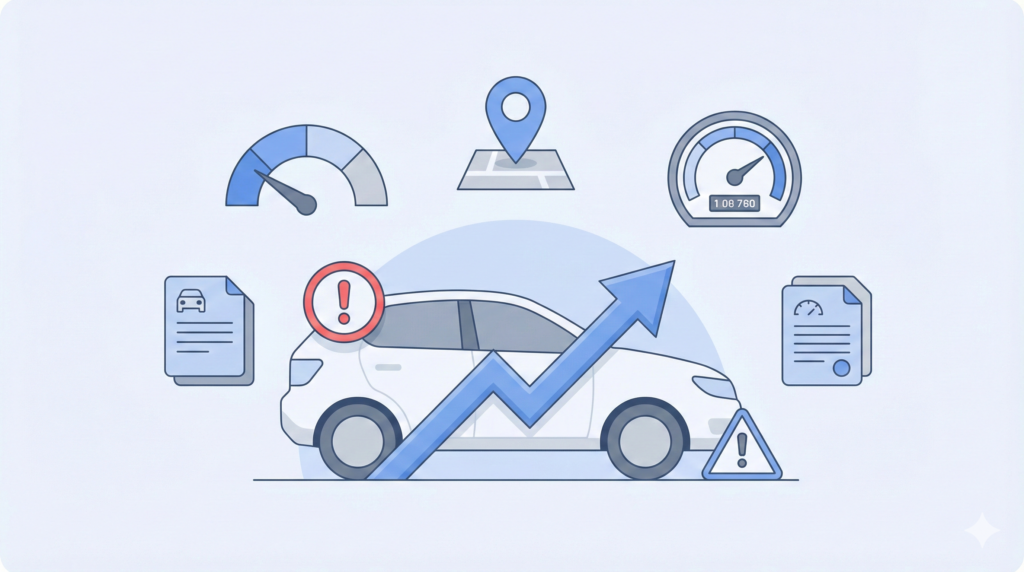
In 2026, many drivers are shocked when their renewal notices arrive with higher-than-expected premiums. Even safe drivers with no recent accidents often wonder why their car insurance quote keep increasing year after year.
The truth is that insurance companies use advanced risk models that analyze dozens of variables—not just how you drive. Small details in your profile can quietly signal “high risk” to insurers, causing you to pay significantly more than necessary.
This guide explains the 10 most common factors that cause car insurance quotes to spike and, more importantly, shows you exactly how to fix them.
Table of Contents
1. Your Driving Record (The “Look-Back” Period)
Your driving history is the single most influential factor insurers use to predict risk. Most companies evaluate a 3–5 year look-back period when calculating car insurance quotes.
Why It Spikes Your Rate
- A single speeding ticket can increase premiums by 20–25%
- DUI or reckless driving violations can double or triple your rate
- At-fault accidents stay on record long after repairs are completed
How to Fix It
- Clean-Slate Strategy: Complete traffic school or a defensive driving course if your state allows point removal
- Time Strategy: Shop for new car insurance quotes once you pass the 3-year mark after a violation
2. Your Credit-Based Insurance Score
In many regions, insurers heavily rely on credit-based insurance scores to assess financial responsibility.
Why It Spikes Your Rate
High credit utilization or missed payments signal higher risk, resulting in higher car insurance quotes—even if your driving record is clean.
How to Fix It
- Check Your Credit Report: Dispute any errors
- Follow the 30% Rule: Keep credit card balances under 30% of available limits
3. Vehicle Make, Model, and Technology
Modern vehicles are expensive to repair—and insurers price that risk accordingly.
Why It Spikes Your Rate
- High repair costs for advanced sensors and cameras
- Popular theft-targeted models increase comprehensive costs
- Sports and luxury vehicles imply aggressive driving risk
How to Fix It
- Pre-Purchase Quote Check: Compare car insurance quotes for multiple models before buying
- Report Safety Features: Ensure all safety and anti-theft systems are listed on your policy
4. Your Age and Driving Experience
Insurance pricing is driven by statistics, not fairness.
Why It Spikes Your Rate
- Drivers under 25 have the highest accident rates
- Drivers over 70 may see rate increases due to slower reaction times
How to Fix It
- Good Student Discount: Maintain a “B” average or higher
- Telematics Programs: Prove safe driving habits regardless of age
5. Your ZIP Code (Location Risk)
Where you live affects your insurance risk profile.
Why It Spikes Your Rate
- Urban areas have higher collision and theft rates
- Regions prone to floods, hail, or hurricanes raise comprehensive costs
How to Fix It
- Garage Parking: Report your vehicle as garaged if applicable
- Update Address Promptly: Moving to a safer area can instantly lower car insurance quotes
6. Coverage Limits and Deductibles
Policy structure plays a major role in pricing.
Why It Spikes Your Rate
- Low deductibles increase insurer payout frequency
- Higher liability limits cost more than state minimums
How to Fix It
- $1,000 Deductible Strategy: Raising deductibles often delivers instant savings
- Remove Unnecessary Add-Ons: Eliminate duplicate roadside or rental coverage
7. A Lapse in Insurance Coverage
Coverage gaps signal instability to insurers.
Why It Spikes Your Rate
Even a short lapse can place you in a high-risk category, increasing car insurance quotes significantly.
How to Fix It
- Never Cancel Early: Activate a new policy before canceling the old one
- Non-Owner Insurance: Maintain coverage when between vehicles
8. Annual Mileage
More driving equals more risk.
Why It Spikes Your Rate
Driving over 20,000 miles annually increases accident probability and premium costs.
How to Fix It
- Work-From-Home Adjustment: Update mileage if commuting has reduced
- Usage Reclassification: Switching from “commuter” to “pleasure” use can lower rates
9. Marital Status and Gender
These demographics still influence pricing in many states.
Why It Spikes Your Rate
Single drivers—especially males under 25—pay higher rates due to historical claim data.
How to Fix It
- Policy Bundling: Auto + renters or home insurance can unlock similar discounts
10. Filing Small Claims
Insurance is designed for major losses—not minor repairs.
Why It Spikes Your Rate
Filing small claims eliminates claims-free discounts and raises long-term premiums.
How to Fix It
- Out-of-Pocket Rule: Pay minor repairs yourself when costs are near your deductible
Frequently Asked Questions (FAQ)
Does checking car insurance quotes increase my premium?
No. Comparing car insurance quotes does not increase your premium. Quote checks are considered soft inquiries and do not affect your credit score or future pricing.
How long do accidents affect car insurance quotes?
Most at-fault accidents impact car insurance quotes for 3 to 5 years, depending on the insurer and severity. Their effect usually reduces after the third year.
Can improving my credit score lower car insurance quotes?
Yes. In many regions, a higher credit-based insurance score can significantly reduce car insurance quotes at renewal or when switching insurers.
Is it better to file a claim or pay out of pocket?
If repair costs are close to your deductible, paying out of pocket is often better. Filing small claims can increase future car insurance quotes and remove claims-free discounts.
How often should I compare car insurance quotes?
Experts recommend comparing car insurance quotes at least once a year or after major life changes such as moving, buying a new car, or changing jobs.
Can raising my deductible really lower my premium?
Yes. Increasing your deductible—often to $1,000—can immediately reduce car insurance quotes, as long as you can comfortably cover the higher out-of-pocket cost.
Conclusion
Understanding how car insurance quotes are calculated gives you control over your financial future. By improving credit health, adjusting deductibles, choosing the right vehicle, and maintaining continuous coverage, you can dramatically reduce premiums.
In a market where car insurance quotes command premium value, insurers actively seek low-risk customers. Fix these 10 factors, and you position yourself as the ideal candidate for the best possible rate in 2026.
Pingback: How to Compare Car Insurance Quotes Effectively in 2026
Pingback: Business Insurance Coverage Best Explained: What Every Business Needs in 2026
Pingback: Life Insurance Policy Best Explained: Term vs Whole Life in 2026
Pingback: Travel Insurance Online Best Explained: What to Know Before You Buy in 2026