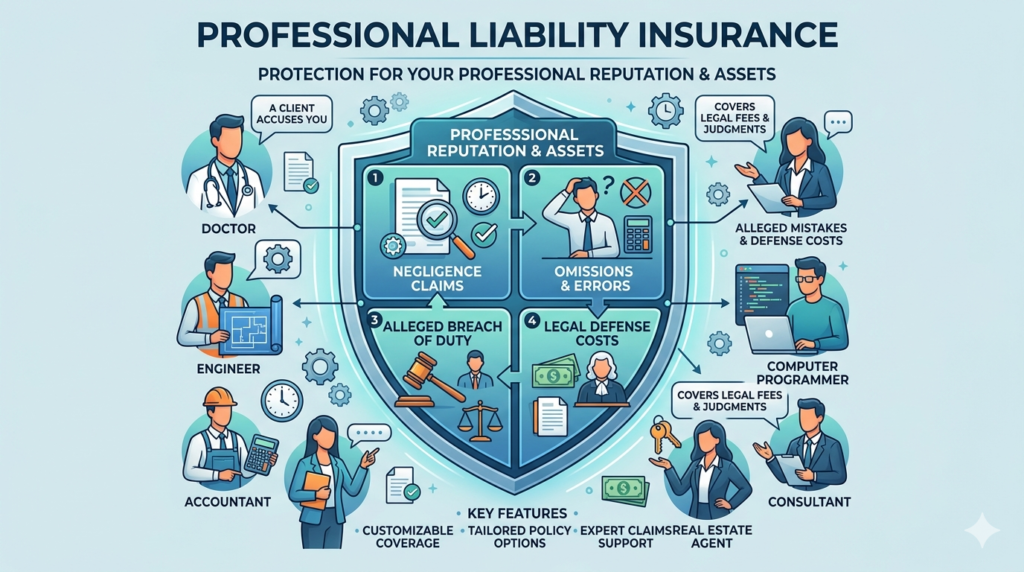
The modern professional landscape is defined by increasing specialization, rapid digital service delivery, and heightened client expectations. While these shifts have created unprecedented growth opportunities, they have also introduced a parallel rise in severe liability exposure. Today, professionals are no longer judged solely on their intent or effort; they are judged on measurable, financial outcomes.
When client expectations are not met whether due to a genuine error, an accidental omission, or perceived negligence crippling legal consequences often follow. In this highly litigious environment, professional liability insurance has evolved from a supplementary safeguard into a non-negotiable, foundational component of corporate risk management.
Commonly referred to as Errors and Omissions (E&O) insurance, this specific form of coverage addresses a critical gap left wide open by standard business policies. It provides a financial safety net against devastating losses resulting from the professional services and advice you provide.
This comprehensive guide provides an expert-level analysis of professional liability insurance. We will examine its architecture, explore the exact scope of its coverage, detail industry-specific risk implications, and provide strategic selection criteria to help businesses and independent professionals secure the right policy.
Table of Contents
What is Professional Liability Insurance?
Professional liability insurance is a specialized commercial policy designed to protect individuals and corporate entities against claims arising from the delivery or the failure to deliver expert professional services.
Unlike General Liability Insurance (which addresses physical, tangible risks such as bodily injury or property damage), professional liability insurance is concerned exclusively with economic or financial harm inflicted upon a client due to your professional advice or services.
At its core, an E&O policy responds to devastating legal allegations, including:
- Professional negligence in executing a service.
- Errors in judgment, calculation, or strategic execution.
- Omissions in service delivery (forgetting to include vital information).
- Misrepresentation of services, timelines, or guaranteed outcomes.
- Failure to meet contractual obligations or industry standards of care.
Importantly, this coverage is triggered not only by proven fault but also by baseless allegations. This distinction is critical for business survival. Even if a client’s lawsuit is entirely frivolous, the legal defense costs required to prove your innocence can easily bankrupt a small to medium-sized enterprise.
The Strategic Importance of E&O Coverage in 2026
Why has professional liability coverage become the cornerstone of modern business protection? The answer lies in the evolving nature of global commerce.
1. The Expansion of Digital Liability Exposure
The digitization of services and global accessibility have significantly expanded the scope of professional liability. A digital marketing consultant or a software developer in one jurisdiction can now directly impact the revenue of a client operating on the other side of the world. Cross-border contracts increase both the complexity of the service and the legal exposure involved.
2. Lower Barriers to Legal Action
Clients today face significantly fewer barriers to initiating legal proceedings. Standardized vendor contracts, increased regulatory awareness, and immediate access to aggressive legal counsel have made litigation more accessible and frequent than in previous decades. A simple misunderstanding over a project deliverable can escalate into a lawsuit within weeks.
3. Financial Fragility of Independent Professionals
For independent contractors, freelancers, and small businesses, a single legal claim—regardless of its actual merit—can result in terminal financial strain. Legal defense costs, attorney retainer fees, and court administration costs can rapidly exceed the operational reserves of a growing company.
4. Contractual and Corporate Mandates
In many high-level sectors, carrying professional liability insurance is no longer optional; it is a strict barrier to entry. Corporate entities, government agencies, and enterprise-level clients frequently mandate a “Proof of Insurance” certificate with specific coverage limits before they will even sign a service agreement. Without it, you are locked out of high-ticket contracts.
Professional Liability vs. General Liability: Understanding the Difference
A frequent and dangerous misconception among new business owners is that standard general liability insurance covers all business risks. This is entirely false. These two forms of insurance serve fundamentally different purposes and are designed to complement one another.
- General Liability Insurance (GLI): Covers tangible, physical risks. If a client visits your office and slips on a wet floor, breaking their arm, your GLI policy covers their medical bills and your legal defense. If you accidentally spill coffee on a client’s server, destroying their hardware, GLI covers the property damage.
- Professional Liability Insurance (PLI): Covers intangible, financial risks. If you provide bad financial advice that causes a client to lose $100,000, your E&O policy covers the damages. If you build a website that crashes during a client’s biggest sale of the year, costing them massive revenue, PLI covers the fallout.
Relying on one while neglecting the other creates a massive, potentially fatal coverage gap in your risk management strategy.
What Does Professional Liability Insurance Actually Cover?
While specific policy structures vary across different insurance carriers, most E&O policies are built upon a foundation of core coverage components. Understanding these is vital to ensuring you aren’t underinsured.
1. Negligence and Breach of Duty
This is the most common trigger for a claim. Coverage extends to allegations that you failed to meet the accepted standard of care within your specific profession. This covers both acts of commission (doing something wrong, like writing faulty code) and acts of omission (failing to do something necessary, like forgetting to file a client’s legal document by a strict deadline).
2. Errors and Omissions in Deliverables
This encompasses a wide range of day-to-day business mistakes, including:
- Providing inaccurate financial or structural analysis.
- Failure to deliver services within the contractually agreed-upon timelines, resulting in client revenue loss.
- Delivering incomplete, bug-ridden, or substandard work.
- Misinterpreting client requirements leading to a useless end-product.
3. Comprehensive Legal Defense Costs
Perhaps the most universally valuable aspect of professional liability insurance is the indemnification of legal defense expenses. Lawyers are incredibly expensive, and this policy component covers:
- Specialized attorney and legal counsel fees.
- Court costs and filing administration fees.
- Expert witness fees required to testify on your behalf.
- Internal investigation and evidence-gathering expenses.
- Note: This coverage actively applies even when the client’s claims are completely unfounded and you win the case.
4. Settlements and Court Judgments
If a claim legitimately results in a negotiated financial settlement or a court-ordered judgment against your business, the insurance policy provides the necessary funds up to your predefined coverage limit, saving your personal and business assets from liquidation.
5. Supplementary Coverage Extensions (Policy Dependent)
Depending on your premium tier and the specific insurer, policies can be enhanced with riders to include:
- Defamation: Protection against claims of libel (written) and slander (spoken).
- Breach of Confidentiality: Accidental leaks of sensitive client data or trade secrets.
- Intellectual Property Disputes: Unintentional copyright or trademark infringement (typically excluding patent infringement).
Critical Coverage Limitations and Exclusions
A sophisticated business owner must read the fine print. Evaluating a policy means understanding exactly what is not covered. Standard industry exclusions typically include:
- Intentional Misconduct or Fraud: Insurance covers mistakes, not malice. If you intentionally deceive a client or commit deliberate fraud, your policy will immediately void the claim.
- Criminal Acts: Any illegal activities or regulatory crimes are strictly excluded.
- Bodily Injury and Property Damage: As previously noted, these fall under the domain of your General Liability policy.
- Employment-Related Disputes: Wrongful termination, workplace harassment, or wage disputes require a separate Employment Practices Liability Insurance (EPLI) policy.
- Cybersecurity Incidents: Unless explicitly added via a specific endorsement, data breaches and ransomware attacks require a dedicated Cyber Liability Insurance policy.
Failure to fully understand these exclusions is the leading cause of denied claims and catastrophic out-of-pocket expenses.
Who Needs Professional Liability Insurance? (Industry Risk Profiles)
The necessity, structure, and cost of professional liability insurance vary wildly depending on the industry. If you provide a service that clients rely on to make money, save money, or protect their health, you need coverage.
Financial Consultants, Traders, and Analysts
Professionals handling market analysis, portfolio management, or technical trading education carry immense liability. If a client claims your financial advice or market analysis led to severe capital loss, E&O insurance is the only barrier between you and total financial ruin.
Logistics and Supply Chain Executives
Consultants in the warehousing and Value Added Services (VAS) sector deal with massive physical inventories and tight fulfillment schedules. An error in supply chain consulting or warehouse management software integration can halt operations, causing millions in delayed shipping damages. E&O protects the consulting firm from the financial fallout of these operational bottlenecks.
Digital Marketing and SEO Agencies
A highly optimized website is a company’s main revenue driver. If an SEO agency utilizes poor practices (like black-hat link building) that result in a client’s website being penalized and de-indexed by Google, the client can sue for lost revenue. E&O covers these digital performance failures.
Healthcare Professionals
In the medical field, professional liability is known as Medical Malpractice Insurance. It covers doctors, nurses, and specialists against claims of misdiagnosis, surgical errors, or substandard patient care.
IT Consultants and Software Developers
Technology professionals face unique risks. If custom software fails, causing a client’s internal network to crash and halting their ability to do business for a week, the developer can be held liable for the business interruption losses.
How Much Does Professional Liability Insurance Cost?
Insurance premiums are not arbitrary; underwriters calculate them based on a complex algorithm of quantitative and qualitative risk factors. While an independent freelance writer might pay $300 a year, a structural engineering firm might pay $15,000 a year.
Key Premium Determinants Include:
- Nature of Services Provided: High-stakes industries (finance, healthcare, architecture) inherently carry a higher potential for catastrophic financial impact, leading to higher baseline premiums.
- Annual Revenue and Client Volume: The more clients you serve and the more money you make, the higher your exposure to a potential lawsuit. Scaling businesses must expect their premiums to scale concurrently.
- Historical Claims Record: A clean history keeps costs low. A record of previous lawsuits or frequent claims significantly elevates your perceived risk profile and your monthly premium.
- Coverage Limits and Deductibles: Choosing a policy with a $2 Million payout limit will cost more than a $500,000 limit. Conversely, agreeing to a higher out-of-pocket deductible (e.g., $5,000 before insurance kicks in) will lower your monthly premium.
- Geographic Jurisdiction: The legal environment heavily influences insurance costs. Businesses operating in highly litigious regions (such as certain US states) will face higher premiums to offset the increased likelihood of court action.
Claims-Made vs. Occurrence-Based Policies: A Vital Distinction
When selecting a policy, you will encounter two distinct structural types. Misunderstanding the difference can leave you completely unprotected.
Most professional liability policies operate on a Claims-Made basis. This means the insurance coverage is triggered when the claim is officially filed by the client, not necessarily when the actual mistake occurred.
This introduces two critical concepts you must manage:
- The Retroactive Date: This is the specific date your coverage began. A claims-made policy will only cover mistakes made after this retroactive date. If a client sues you today for a mistake you made three years ago, but your retroactive date was only established last year, you are not covered.
- The Continuous Coverage Requirement: Because claims-made policies require the policy to be active when the claim is reported, any lapse or gap in your insurance coverage instantly wipes out your protection for all past work. If you retire or close your business, you must purchase “Tail Coverage” (an Extended Reporting Period) to remain protected against future lawsuits arising from your past services.
Strategic Guide to Choosing the Right Insurance Policy
Selecting the optimal professional liability policy requires a meticulous, structured evaluation process. Do not simply click “buy” on the cheapest quote.
Step 1: Conduct a Ruthless Risk Assessment
Evaluate your exact service scope. Identify your worst-case scenario. If your service completely fails, how much money stands to be lost by your biggest client? Use this number to determine your required coverage limits.
Step 2: Analyze Client Contractual Requirements
Before shopping for quotes, review your Master Service Agreements (MSAs) with your current clients. Many enterprise clients dictate minimum insurance requirements (e.g., “$1,000,000 aggregate E&O coverage”). Ensure your new policy meets or exceeds these contractual stipulations.
Step 3: Perform a Comparative Analysis
Evaluate multiple insurance carriers. Look beyond the monthly premium cost and investigate:
- Industry Specialization: Does the insurer actually understand the nuances of your specific profession?
- Financial Strength: Check their A.M. Best rating to ensure they have the financial reserves to actually pay out a massive claim.
- Claims Handling Reputation: Read independent reviews on how aggressively the insurer defends its policyholders in court.
Step 4: Scrutinize the Policy Language
Never sign an insurance contract without reading the definitions. Pay particular attention to the “Exclusions” section. Understand exactly how the insurer defines a “covered service” and ensure it matches what you actually do on a daily basis.
Beyond Insurance: Operational Risk Mitigation Strategies
Insurance should never be viewed as a substitute for competent risk management; it is merely the final safety net. To prevent claims from happening in the first place, implement the following operational strategies:
- Ironclad Contractual Clarity: Ambiguity breeds litigation. Ensure your Statements of Work (SOW) clearly define deliverables, strict timelines, and, most importantly, what is out of scope.
- Meticulous Documentation Practices: Maintain exhaustive records of all client communications, approvals, and revision requests. If a client approves a risky strategy in writing, that email is your primary defense against a future lawsuit.
- Quality Assurance (QA) Checklists: Implement systematic, peer-reviewed QA mechanisms to catch errors before deliverables are sent to the client.
- Proactive Client Communication: Over-communicate. If a project is falling behind schedule, transparently inform the client immediately. Most lawsuits are born from a breakdown in communication and sudden, negative surprises.
Conclusion: An Investment in Business Longevity
Professional liability insurance represents the ultimate safety mechanism in modern business risk management. As service delivery becomes increasingly intertwined with client revenue, the margin for error effectively drops to zero. In this high-stakes environment, even the most meticulous, highly competent professionals are vulnerable to devastating claims.
The decision to secure a robust E&O policy should not be viewed as a burdensome compliance cost. Instead, view it through the lens of long-term business resilience.
A well-structured professional liability policy does more than provide financial reimbursement—it enables you to operate aggressively, confidently pursue high-value enterprise contracts, and maintain an authoritative, credible standing in an increasingly scrutinized global marketplace. Ultimately, the true value of professional liability insurance is realized not in its mere presence on a ledger, but in its unwavering performance when your business needs it most.
Frequently Asked Questions (FAQ)
Is professional liability insurance mandatory by law?
While not universally required by federal law for all professions, it is legally mandated for certain licensed fields (like medicine and law). Furthermore, it is frequently a strict contractual requirement dictated by corporate clients, industry regulatory bodies, and professional associations.
Can freelancers and independent contractors get E&O insurance?
Absolutely. In fact, independent professionals are highly encouraged to carry it. Freelancers lack the legal and financial shielding of a large corporation, making their personal assets highly vulnerable to business-related lawsuits. There are specific, highly affordable policies designed explicitly for solo consultants.
Does an E&O policy cover past work if I just buy it today?
Generally, no. Most policies operate on a claims-made basis and include a “retroactive date” (usually the day the policy begins). Incidents that occurred before this date are not covered. To cover past work, you must specifically negotiate a “prior acts” coverage clause with your insurer.
Are professional liability insurance premiums tax-deductible?
In most jurisdictions, commercial insurance premiums are classified as standard, ordinary, and necessary business expenses. Therefore, they are typically fully tax-deductible. However, it is always recommended to consult with a certified public accountant (CPA) regarding your specific tax situation.
What is the difference between E&O and Cyber Liability Insurance?
E&O covers mistakes in your professional services (e.g., bad advice, coding errors). Cyber Liability Insurance covers the specific fallout from malicious data breaches, ransomware attacks, and the exposure of sensitive client data by third-party hackers. Many modern businesses require both to be fully protected.
Sources
- Insurance Information Institute – Professional Liability Insurance
- U.S. Small Business Administration – Business Insurance Basics