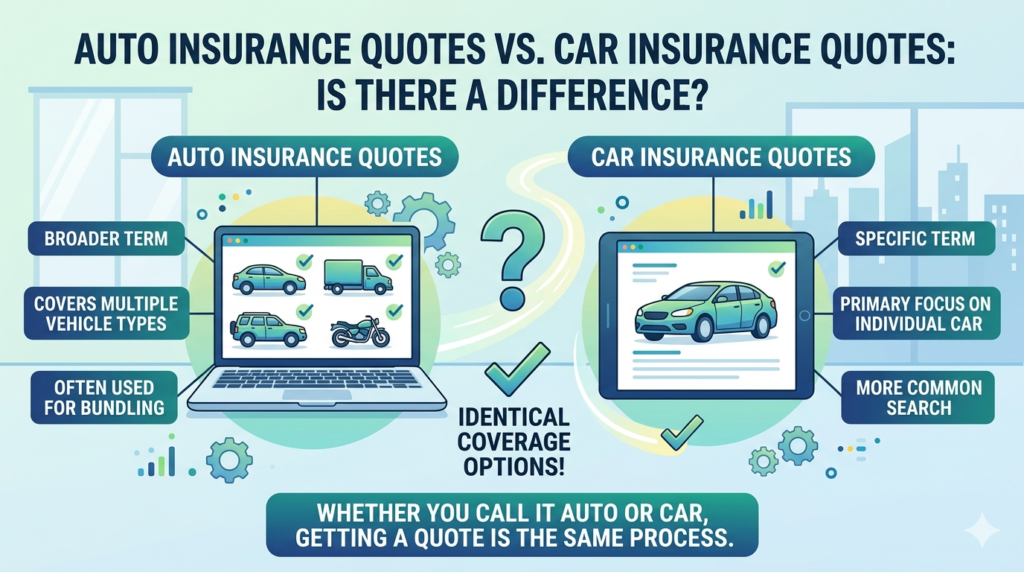
If you have ever spent time searching for vehicle protection online, you have undoubtedly seen the terms auto insurance quotes and car insurance quotes used interchangeably. From late-night television commercials to massive online comparison aggregators, the insurance industry seems to treat these two phrases as identical synonyms.
Many drivers assume they mean exactly the same thing. However, in the complex, highly regulated insurance landscape of 2026, the distinction between these two terms matters significantly more than most consumers realize.
While both terms undeniably relate to the pricing of vehicle insurance, they are utilized in fundamentally different contexts by insurance underwriters, legal policy documents, and commercial rating algorithms. The evolution of how we use vehicles shifting from simple daily commuting to gig-economy delivery, ridesharing, and mobile business operations has forced the insurance industry to draw a hard line in the sand regarding risk classification.
Using the wrong terminology when requesting a quote isn’t just an issue of semantics; it is an issue of financial liability. Misunderstanding what you are actually buying can lead to wildly incorrect pricing, catastrophic coverage gaps, and, worst of all, the complete denial of a major claim when you need it most.
This comprehensive guide serves as your ultimate resource for decoding insurance terminology in 2026. We will explain exactly what auto insurance quotes and car insurance quotes really mean, how actuarial algorithms classify your vehicle usage, the immense impact of the modern gig economy, and which specific quote type you must focus on to legally protect your assets.
Table of Contents
The Linguistic Evolution: Why the Confusion Exists
To understand why the terminology matters, we must first look at how the insurance industry evolved. Historically, the word “automobile” was a blanket term encompassing virtually any motorized, self-propelled vehicle designed for passenger or cargo transport on public roads. The word “car” was simply a colloquial abbreviation for a standard, four-wheeled passenger vehicle.
For decades, insurance companies marketed “Auto Insurance” as the official, legal product, while consumers colloquially searched for “Car Insurance.”
However, as the automotive market fractured into highly specific vehicle classes—SUVs, heavy-duty pickup trucks, commercial transit vans, electric vehicles, and specialized delivery vehicles—insurers had to separate personal, everyday driving risk from commercial, heavy-duty risk.
Today, “car insurance” has become the universally accepted shorthand for standard, personal-use coverage, while “auto insurance” has retained its status as the massive, umbrella term that encompasses personal use, commercial operations, fleet management, and specialized vehicle coverage.
Deep Dive: What Are “Car Insurance Quotes”?
When an insurance provider or a comparison website refers specifically to car insurance quotes, they are almost exclusively referring to pricing estimates for a Personal Auto Policy (PAP).
This is the standard, everyday insurance policy that 85% of the driving public requires. It is meticulously designed, priced, and heavily regulated by state governments to cover the financial risks associated with the routine, non-commercial use of a standard passenger vehicle.
Typical Characteristics of Car Insurance Quotes:
- Vehicle Types: Sedans, coupes, minivans, standard SUVs, and light-duty pickup trucks that are not heavily modified for commercial hauling.
- Primary Usage: The vehicle is used strictly for personal commuting to and from a primary workplace, running household errands, picking up children from school, and leisure travel or road trips.
- Driver Classification: The policy covers a single primary driver, or a defined household of drivers (such as a spouse and teenage children).
- Ownership Structure: The vehicle is titled and registered strictly in the name of an individual person, not a Limited Liability Company (LLC) or a corporate entity.
- Risk Profile: Because the driving patterns are highly predictable (e.g., driving 15 miles to the office and parking the car in a safe lot for 8 hours), the actuarial risk classification is considered “Low to Moderate.”
Who Should Focus on Car Insurance Quotes?
If you are a student, a retiree, a remote worker, or a traditional W-2 employee who simply needs to legally drive from Point A to Point B without conducting any form of business from the driver’s seat, standard car insurance quotes are your exact target. They offer straightforward liability, collision, and comprehensive coverage tailored to the everyday consumer.
Deep Dive: What Are “Auto Insurance Quotes”?
In contrast, auto insurance quotes represent a much broader, overarching category. While a personal car insurance quote fits inside the auto insurance umbrella, the term “auto” is frequently utilized by brokers and commercial carriers to signal coverage that goes far beyond a simple commute to the grocery store.
When you request an “auto insurance quote” from a specialized commercial broker, the system assumes you may be engaging in activities that carry a significantly higher liability risk.
What Auto Insurance Quotes Often Encompass:
- Commercial Auto Insurance: Coverage for vehicles used specifically to conduct business. This includes fleets of plumbing vans, landscaping trucks, heavy-duty construction vehicles, and corporate executive cars.
- Non-Standard Vehicles: Quotes for vehicles that do not fit the personal car mold, such as flatbed trucks, refrigerated delivery vans, or vehicles with a Gross Vehicle Weight Rating (GVWR) exceeding 10,000 pounds.
- High-Liability Operations: Businesses carry more liability than individuals. If a plumber driving a company van rear-ends a school bus, the victims will sue the plumbing company for millions. Therefore, commercial auto insurance quotes often offer liability limits of $1,000,000 to $5,000,000—limits that are simply unavailable on standard personal car insurance quotes.
- Multiple and Fluid Drivers: A commercial auto policy allows any official employee of the company to drive the insured vehicle, whereas a personal car policy strictly limits coverage to named family members.
Because of this significantly wider scope, auto insurance quotes usually feature a more exhaustive underwriting process, ask highly detailed questions about cargo and daily mileage, and generally result in higher premiums to offset the massive commercial risk.
The 2026 Game Changer: The Gig Economy and Ridesharing
The absolute most critical reason you must understand the difference between these terms in 2026 is the explosion of the gig economy.
Ten years ago, the line between “personal use” and “business use” was clear. Today, that line has been completely obliterated. Millions of drivers now use their personal, four-door sedans to drive for Uber or Lyft, deliver food for DoorDash or UberEats, or transport packages for Amazon Flex.
Here is the harsh reality: A standard personal car insurance policy explicitly excludes any coverage the moment you log into a digital gig-economy application to make money.
The “Livery” Exclusion
Almost every personal car insurance policy contains a “livery conveyance exclusion.” This legal clause states that the insurance company will not pay a single dime if you get into an accident while using your vehicle to transport people or property for a fee.
If you request standard “car insurance quotes” but you secretly drive for DoorDash on the weekends, you are driving completely uninsured during your shifts. If you hit a pedestrian while delivering a pizza, your personal car insurance will deny the claim, cancel your policy for fraud, and leave you personally responsible for hundreds of thousands of dollars in medical bills.
The Solution: Rideshare and Delivery Endorsements
Gig economy workers must seek out specialized auto insurance quotes that offer a “Transportation Network Company (TNC) Endorsement” or a “Rideshare Rider.” This bridges the gap between a standard personal car policy and a massive commercial auto policy, providing specialized coverage specifically designed for the modern side-hustle.
Auto Insurance Quotes vs. Car Insurance Quotes: The Ultimate Breakdown
To make the distinction perfectly clear, here is a comparative analysis of how the insurance industry differentiates the two classifications:
| Feature / Metric | Car Insurance Quotes (Personal) | Auto Insurance Quotes (Commercial/Broader) |
| Primary Usage Type | Personal commuting, errands, leisure. | Business operations, gig-economy, hauling, fleets. |
| Vehicle Registration | Titled to an individual person. | Titled to an individual, an LLC, or a Corporation. |
| Risk Scope | Narrow. Predictable driving patterns. | Broad. High mileage, unpredictable routes, hauling heavy cargo. |
| Common Search Intent | Everyday individuals, families, students. | Small business owners, contractors, Uber drivers. |
| Liability Limits | Capped lower (usually maxes out around $500,000). | Extremely high (often $1,000,000 to $5,000,000+). |
| Pricing Baseline | Generally lower and more affordable. | Can be significantly higher due to elevated business risk. |
| Coverage Flexibility | Standardized, state-regulated packages. | Highly customizable with specialized cargo and equipment endorsements. |
Understanding this structural difference prevents you from buying a policy that leaves you dangerously exposed to financial ruin.
The Underwriting Process: How Insurers Determine Your Classification
You cannot simply choose to buy a cheaper “car insurance quote” if your reality dictates that you need a commercial “auto insurance quote.” Insurance companies employ armies of underwriters and sophisticated data verification algorithms to classify your true vehicle usage.
When generating your quote, insurers will scrutinize:
- Declared Annual Mileage: If you claim your vehicle is for “personal use,” but you are logging 45,000 miles a year, the algorithm will flag your profile for suspected commercial use.
- Vehicle Modifications: Do you have ladder racks, permanent toolboxes, or heavy-duty hydraulic lifts installed? These instantly classify the vehicle as commercial.
- Vehicle Signage: If your vehicle has a permanent vinyl wrap or magnetic decals advertising your LLC or your landscaping business, standard personal car insurance will not cover it.
- Ownership Structure Verification: If the underwriter pulls the DMV registration and sees the car is titled to “Smith Plumbing LLC” rather than “John Smith,” a personal car insurance quote is immediately voided.
Misrepresenting your vehicle’s usage—even unintentionally to save a few dollars—is legally defined as “soft insurance fraud.” It is the number one reason claims are denied in 2026.
Scenario Guide: When Should You Use Which Quote Type?
To ensure you are shopping in the correct marketplace, identify which of the following real-world scenarios best matches your current lifestyle.
Scenario A: The Daily Commuter (Use Car Insurance Quotes)
You are an accountant who drives 12 miles to work every morning. On the weekends, you drive your kids to soccer practice and go grocery shopping. The car is registered in your name.
- Verdict: You represent the standard personal risk profile. You should focus exclusively on finding the best car insurance quotes.
Scenario B: The Small Business Owner (Use Auto Insurance Quotes)
You own a boutique bakery. You use a customized transit van to deliver multi-tiered wedding cakes to various venues every Saturday. The van is registered to your bakery’s LLC.
- Verdict: Because the vehicle is integral to your business revenue, carries commercial goods, and is owned by a corporate entity, personal coverage is useless. You must seek out commercial auto insurance quotes.
Scenario C: The Side-Hustle Contractor (Use Auto/Rideshare Quotes)
You work a standard office job from Monday to Friday, but on Friday and Saturday nights, you drive your personal Honda Civic for Uber to make extra cash.
- Verdict: You have a mixed-use risk profile. You need to shop for personal car insurance quotes that explicitly allow the addition of a Rideshare/TNC Endorsement. Do not hide your side hustle from the quoting agent.
Scenario D: The Tradesperson (Use Auto Insurance Quotes)
You are an independent electrician. You drive a heavy-duty Ford F-250 filled with $15,000 worth of copper wire, specialized tools, and electrical meters. You drive to four different client houses a day.
- Verdict: Standard personal policies will not cover the theft or destruction of thousands of dollars of commercial tools. You need a robust commercial auto insurance quote with an “Inland Marine” or “Tools and Equipment” rider.
5 Common and Costly Mistakes Drivers Make When Comparing Quotes
The sheer volume of online aggregators makes it incredibly easy to click the wrong button and purchase inadequate coverage. Avoid these frequent policyholder errors:
- Selecting Personal Car Insurance While Using the Vehicle for Work: As reiterated above, if you transport clients, deliver goods, or haul heavy commercial equipment, standard personal quotes will leave you exposed to massive lawsuits.
- Assuming “Auto Insurance” Always Means Commercial Coverage: While “auto” leans toward commercial, it is still used interchangeably by many massive consumer brands. Always clarify the exact legal parameters of the policy. Ask the agent directly: “Is this a Personal Auto Policy or a Commercial Auto Policy?”
- Focusing Only on Price Instead of Coverage Scope: Commercial auto quotes are inherently more expensive than personal car quotes. Many business owners make the mistake of buying a personal policy simply because it is $100 cheaper a month. When their work truck is totaled and the claim is denied, that $100 “savings” ends up costing them $40,000.
- Failing to Update Usage After a Lifestyle Change: If you bought a personal car insurance policy two years ago, but three months ago you started a mobile dog-grooming business out of the back of your SUV, your policy is outdated. You must update your insurer immediately when your vehicle usage changes.
- Comparing Apples to Oranges: When reviewing multiple quotes, ensure the coverage limits match exactly. Do not compare a personal car quote with $50,000 in liability against a commercial auto quote with $1,000,000 in liability and assume the commercial one is just a “rip-off.”
How to Compare Quotes the Right Way in 2026
Regardless of whether you ultimately need a personal or commercial policy, the strategy for securing the best rate remains the same. Do not blindly accept the first price generated by a website.
- Declare Your Usage Brutally Honestly: Honesty is the only policy. Tell the quoting engine or the broker exactly what you do with the car, how many miles you drive, and if anyone else drives it.
- Match Coverage Limits Across the Board: When looking at three different quotes, ensure every single one offers the exact same Bodily Injury Limits, Property Damage Limits, and Comprehensive/Collision Deductibles.
- Scrutinize the Exclusions Page: Before signing a contract, read the “Exclusions” section of the declaration page. This is where the insurer tells you exactly what they will not cover. Ensure your daily activities do not violate any of these listed exclusions.
- Vet the Insurer’s Reputation: A cheap quote is entirely worthless if the insurance company is notorious for fighting payouts and ignoring customer phone calls. Check the carrier’s J.D. Power claims satisfaction rating and their AM Best financial strength rating.
The Long-Term Impact on Your Financial Security
The distinction between auto and car insurance in 2026 is far more than a marketing technicality. Choosing the correct quote type fundamentally affects your long-term insurability.
If you attempt to game the system by purchasing a cheap personal car insurance quote for your delivery business, you are playing a dangerous game of financial roulette. When (not if) an accident occurs and the claims adjuster discovers you were delivering goods, they will deny the claim.
Furthermore, your policy will be canceled for misrepresentation, and you will be placed in a high-risk national database. Finding any insurance company willing to cover you after a policy cancellation for fraud is incredibly difficult, and the premiums you will face will be astronomical. Using the wrong quote type may save you fifty dollars in the short term, but it could cost you your entire business in the long term.
Frequently Asked Questions (FAQ)
Are auto insurance quotes and car insurance quotes literally the same thing?
In casual conversation, yes. But in the legal and underwriting reality of 2026, no. “Car insurance” almost universally refers to standard, personal-use passenger vehicles. “Auto insurance” is a broader umbrella term that frequently denotes commercial use, business fleets, and heavy-duty vehicles.
I just started driving for Uber. Do I have to cancel my car insurance and buy commercial auto insurance?
Not necessarily. For gig-economy workers, many major insurers offer a middle-ground solution. You keep your personal car insurance policy but add a specific “Rideshare Endorsement” for an additional monthly fee. However, you must inform your insurer; if you do not, your standard policy will not cover you while the app is active.
Can I switch from a personal car insurance policy to a commercial auto policy later?
Absolutely. In fact, you are legally required to do so if the primary usage of your vehicle changes. If you transition from being a W-2 office worker to starting your own plumbing business using the same truck, you simply call your agent, cancel the personal policy, and rewrite it as a commercial auto policy.
Will using the wrong quote type actually result in a denied claim?
Yes. Claims adjusters are highly trained investigators. If you get into an accident and there are business tools scattered across the highway, or the police report notes you were delivering a package, the adjuster will cross-reference this with your “personal use only” policy and deny the payout entirely.
Which quote type is generally cheaper?
Personal car insurance quotes are significantly cheaper. This is because standard commuting carries a massively lower actuarial risk profile than operating a vehicle for daily business operations, which requires higher liability limits to protect corporate assets.
Conclusion: Securing Your Assets with the Right Terminology
In the hyper-connected, gig-driven economy of 2026, the difference between auto insurance quotes and car insurance quotes is far more than just semantics—it is a reflection of how the global insurance industry categorizes risk, determines financial liability, and approves life-saving coverage.
As the line between our personal and professional lives continues to blur, absolute clarity with your insurance provider is your greatest defense. Misrepresenting your daily vehicle usage to secure a cheaper rate is a critical error that can instantly void your financial safety net.
The smartest approach to shopping for vehicle protection is not merely hunting for the lowest absolute price. The goal is to find the specific quote—whether a standard personal car policy or a robust commercial auto policy—that truly and legally matches how you utilize your vehicle. By understanding the terminology, demanding the right coverage endorsements, and actively comparing quotes across top-tier carriers, you guarantee that your policy will actually perform when you need it most.
Sources
- Insurance Information Institute – Auto Insurance Basics
- Consumer Financial Protection Bureau – What Is Auto Insurance?