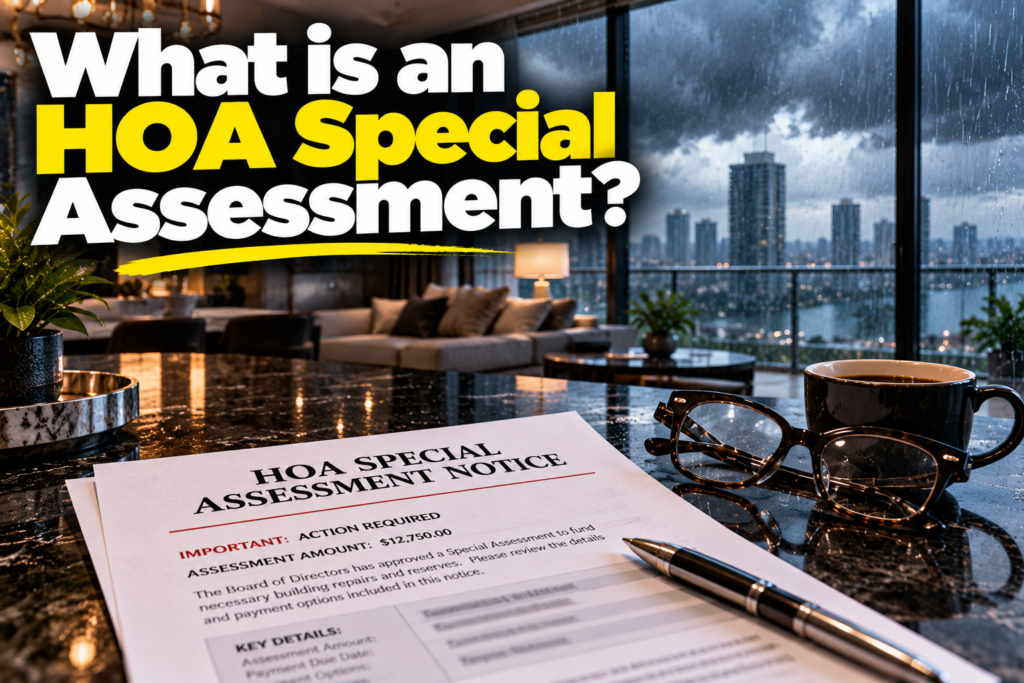
You just opened an envelope from your Homeowners Association. The board is levying a $10,000 special assessment to replace the community roof, payable in 30 days. The panic sets in. You desperately hope your personal policy will step in. But does HO-6 insurance cover HOA special assessment for roof replacements? The brutal truth: it depends entirely on the exact cause of the damage. Insurance covers sudden disasters, not bad HOA budgeting. Here is how adjusters scrutinize these claims.
Understanding the Condo Insurance Ecosystem
To understand how a special assessment claim works, you must first understand the structural dividing line in condominium insurance.
When you buy a condo, you are operating under a dual-insurance system. The HOA holds a Master Policy. This massive commercial policy covers the “common elements” of the building—the foundation, the exterior siding, the elevators, the lobby, and the roof.
You hold an HO-6 Policy (condo insurance). This personal policy covers everything from the “walls-in.” It protects your personal property, your interior upgrades (like custom cabinets or hardwood floors), and your personal liability.
Because you do not own the roof, your standard Dwelling Coverage (Coverage A) does not pay to fix it. Instead, the bridge between your personal policy and the HOA’s Master Policy is a highly specific rider called Loss Assessment Coverage.
The “Covered Peril” Reality Check
Loss Assessment coverage is the only mechanism on your HO-6 policy that can pay an HOA bill. However, it comes with a strict, non-negotiable legal trigger: the underlying damage must be caused by a Covered Peril.
A Covered Peril is a sudden, accidental, and catastrophic event. Think lightning strikes, massive hail storms, tornadoes, or a catastrophic fire.
If the HOA issues a $10,000 special assessment because the roof was severely damaged by a documented F-2 tornado last month, your Loss Assessment coverage will trigger. You were hit by a Covered Peril.
Now, consider the alternative.
Your HOA board sends a letter stating the roof is 25 years old. The asphalt shingles are curling, and the underlayment is rotting. The board’s reserve fund is completely empty because they artificially suppressed monthly dues to keep residents happy for a decade. Now, the roof is failing, and they need $500,000 immediately. They assess each of the 50 unit owners $10,000.
Will your HO-6 insurance pay this assessment? Absolutely not.
This is deferred maintenance. Insurance companies classify this as “wear-and-tear,” which is universally excluded from every property and casualty contract on earth. Insurance is a shield against unpredictable disasters. It is not a financial bailout for a mismanaged HOA budget. If the assessment is due to old age and rot, you will pay every single dollar of that $10,000 out of your own pocket. Full stop.
Does HO-6 Insurance Cover HOA Special Assessment for Roof Deductibles?
One of the most complex scenarios involves the Master Policy deductible. Often, the HOA does file a successful claim on their Master Policy for a covered storm. But there is a massive catch.
Commercial Master Policies frequently carry a “percentage deductible” for windstorm and hail damage. Instead of a flat $5,000 deductible, the HOA might have a 5% wind/hail deductible based on the total replacement cost of the entire building.
If your condo building is valued at $10 million, a 5% deductible is $500,000.
A massive hail storm shreds the roof. The total repair cost is $800,000. The HOA’s Master Policy carrier approves the claim, but subtracts the $500,000 deductible, issuing a check for only $300,000. The HOA board now has a $500,000 shortfall. They legally pass this shortfall down to the unit owners, assessing you $10,000 to cover your share of the Master Policy deductible.
Does your HO-6 cover this? Yes.
Because the root cause of the assessment was a Covered Peril (hail), your HO-6 Loss Assessment coverage can step in and pay your share of the HOA’s massive commercial deductible.
Table 1: The HOA Roof Assessment “Will It Be Covered?” Matrix
| Assessment Scenario | Covered by HO-6? | The Adjuster’s Reasoning |
| Roof is 25 years old and actively leaking due to rot. | No. | Wear-and-tear and deferred maintenance are explicitly excluded. |
| A microburst tears 40% of the shingles off the building. | Yes. | Windstorm is a named, sudden Covered Peril. |
| HOA assesses owners to pay a $100k Master Policy hail deductible. | Yes. | The root cause (hail) is a Covered Peril, triggering Loss Assessment. |
| HOA wants to upgrade from asphalt to a premium metal roof. | No. | Betterment and elective upgrades are never covered by insurance. |
| Termites compromised the roof trusses over a 5-year period. | No. | Pest damage and long-term infestations are excluded maintenance issues. |
The Pathetic Default Limit (Why $1,000 Won’t Save You)
Even if you survive the Covered Peril reality check, you are likely walking into a brutal mathematical trap.
When you buy a standard HO-6 policy online, the quoting algorithm defaults your Loss Assessment coverage to a meager $1,000. Most condo owners never look at this line item.
If a catastrophic fire destroys the community roof and the HOA assesses you $15,000, your insurance company will send you a check for $1,000. You are legally responsible for the remaining $14,000.
This is an entirely preventable financial disaster. Increasing your Loss Assessment coverage limit from $1,000 to $50,000 is incredibly cheap. Because massive covered peril assessments are statistically rare, underwriters typically charge less than $20 or $30 a year for this maximum upgrade. It is the highest-ROI endorsement you can put on a condo policy. However, you cannot add it retroactively. The coverage must be in place before the storm forms.
Date of Loss vs. Date of Assessment (The Timeline Trap)
Condominium claims are notoriously slow. The timeline between the physical damage occurring and you receiving a bill can take years.
Imagine a severe hurricane damages the community roof in August 2024. The HOA board fights with their Master Policy insurance adjuster for 18 months over the payout amount. They finally lose the arbitration in February 2026. The board sends you a special assessment letter in March 2026.
You switched your personal HO-6 insurance carrier in January 2025 to save a few dollars. Which insurance company do you file your Loss Assessment claim with?
You must file the claim with the insurance company that insured you on the Date of Loss (August 2024).
Insurance policies respond to the exact date the physical damage occurred, not the date the HOA finally got around to sending the invoice. You will have to call your old insurance carrier, reopen a dead file, and prove you had adequate Loss Assessment limits active on the day the hurricane made landfall.
The Condo Owner’s Actionable Walkthrough
When that dreaded HOA letter arrives in your mailbox, do not immediately write a check from your savings account. Execute this clinical, four-step workflow to determine your coverage.
Step 1: Scrutinize the Stated Cause
Read the HOA assessment letter line by line. Look for the exact phrasing defining the cause of the roof replacement. Does it mention “wind damage from the May 12th storm”? Or does it use phrases like “end of useful life,” “preventative maintenance,” or “replacing the aging roof”? If it is the latter, do not bother filing an insurance claim. It will be denied.
Step 2: Check Your Declarations Page
Pull out your personal HO-6 policy documents. Look at the single summary page at the front (the Declarations Page). Scan down to “Loss Assessment.” If that number says $1,000, that is your absolute maximum payout.
Step 3: Request the Master Policy Paper trail
If the damage was caused by a storm, the HOA board should have filed a claim on their Master Policy first. Demand that the HOA board provide you with a copy of the Master Policy adjuster’s “Statement of Loss” or the official Denial Letter. Your personal HO-6 claims adjuster will absolutely require this documentation to prove that the HOA actually suffered a covered loss before they will release any Loss Assessment funds to you.
Step 4: File the Claim Formally
Call your broker or your carrier’s claims hotline. Provide them with the HOA assessment letter, the date the storm occurred, and the Master Policy documentation. Be prepared to pay your personal HO-6 deductible (usually $500 or $1,000) before the Loss Assessment funds are disbursed.
Owning a condo means your financial stability is deeply tethered to the competence of your HOA board. You cannot control their budgeting, and you cannot stop a hailstorm. The only variable you control is your policy limit. Stop reading this, pull up your HO-6 declarations page, and call your broker right now to increase your Loss Assessment coverage to a minimum of $50,000. It is the cheapest sleep you will ever buy.