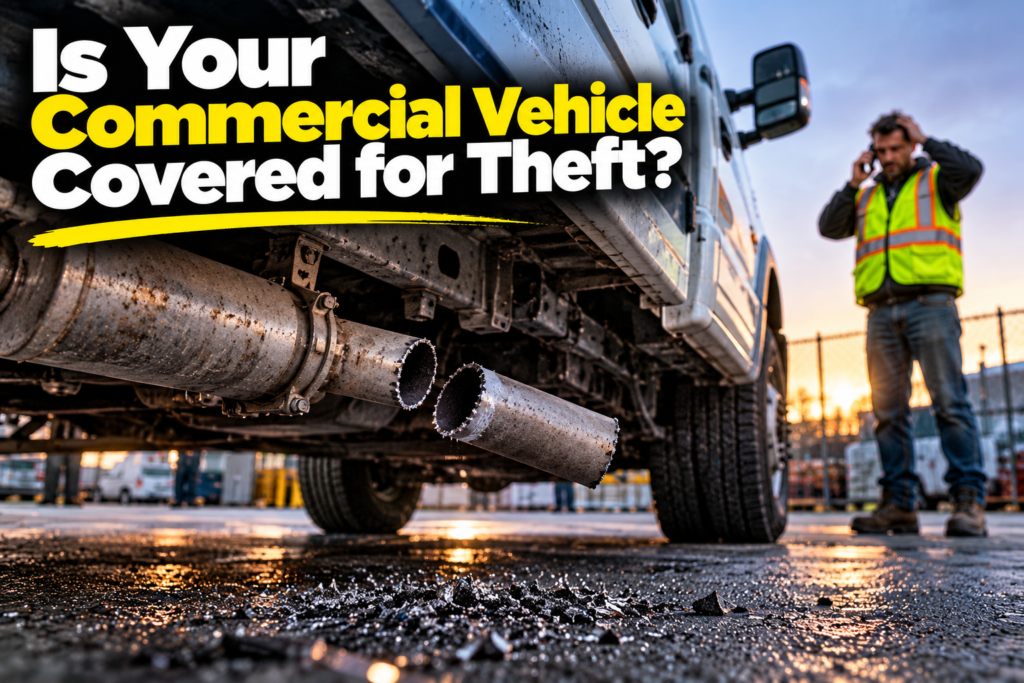
You turn the key to your F-250 work truck and a deafening roar shakes the chassis. A thief just cut your exhaust. The truck is grounded. Now you cannot reach the job site, and your crew is standing around costing you hourly wages. You need to know: how does a commercial auto insurance stolen catalytic converter claim actually work when the vehicle is leased? Yes, your policy covers the theft. But filing a formal claim immediately is a rookie mistake. Here is the financial reality of commercial deductibles, leasing company mandates, and hidden downtime.
The Coverage Reality: Comprehensive vs. Collision
In commercial property and casualty insurance, theft is never classified as a collision. Catalytic converter theft falls strictly under your Comprehensive coverage tier (often labeled “Other Than Collision” on your declarations page).
Because your work truck is leased, you do not hold the title. The leasing company is the legal owner and the designated “Loss Payee” on your insurance contract. To protect their asset, the leasing company absolutely mandated that you carry Comprehensive coverage before they handed you the keys.
So legally, yes, the coverage is in place. The carrier will acknowledge the theft. But acknowledging a theft and actually cutting you a check are two entirely different things.
How a Commercial Auto Insurance Stolen Catalytic Converter Claim Triggers the Deductible Trap
This is the most critical financial trap for small business owners and fleet managers. Standard personal car insurance usually carries a low $500 deductible. Commercial auto policies operate on an entirely different scale. To keep fleet premiums mathematically viable, brokers typically structure commercial auto policies with heavy deductibles—usually ranging from $1,000 to $2,500.
Your deductible is the cash threshold you must cross before the insurance company pays a single dollar.
Catalytic converter replacement costs fluctuate wildly based on the make and model of the commercial vehicle. A standard Ford Transit van might cost $1,800 to fix. A heavy-duty Mitsubishi Fuso or a Ford F-450 Super Duty could cost $3,500 to repair, largely due to the specialized precious metals (rhodium, palladium, platinum) required to filter diesel emissions.
If your repair estimate is $1,900, and your commercial comprehensive deductible is $2,000, your insurance payout is exactly $0.
Worse, if you blindly call your insurance agent to report the theft before getting a repair estimate, the carrier will open a claim file. Even if they pay out nothing, that incident is logged as a comprehensive loss on your C.L.U.E. (Comprehensive Loss Underwriting Exchange) report. Underwriters view businesses with frequent theft claims as a localized risk. A $0 payout claim for a stolen exhaust can trigger a premium hike at your next annual renewal.
You must do the math before you make the call.
Table 1: The “To Claim or Not to Claim” Decision Matrix
| Scenario | Repair Estimate | Your Deductible | The Math | Broker’s Advice |
| A | $1,500 | $2,000 | You are $500 under the deductible limit. | Pay Cash. Do not notify your insurer. Fix it out of pocket to protect your loss history. |
| B | $2,500 | $1,000 | Insurance pays $1,500. You pay $1,000. | File the Claim. The $1,500 payout justifies the strike on your loss history. |
| C | $2,100 | $2,000 | Insurance pays $100. You pay $2,000. | Pay Cash. Filing a formal claim to receive a $100 check is financial suicide for your future renewal rates. |
The OEM vs. Aftermarket War (The Leasing Company’s Wrath)
If the math dictates that you should file a claim, you are about to enter a battle with the insurance adjuster over parts.
Insurance companies optimize for cost mitigation. When an adjuster writes the repair estimate for your stolen catalytic converter, they will almost always default to pricing out a cheap, aftermarket “universal” converter or a straight-pipe workaround.
You cannot allow this. The truck is leased.
Your lease agreement contains a strict clause regarding repairs. When you return that truck at the end of the lease term, the leasing company expects it to be in factory-grade condition. If their inspectors slide under the chassis and see a welded aftermarket exhaust system, they will penalize you heavily. You will be billed for the cost of an Original Equipment Manufacturer (OEM) catalytic converter, plus labor, effectively forcing you to pay for the repair twice.
You must force the insurance adjuster to approve OEM parts. Because the leasing company is the Loss Payee, you can use their contract as leverage. Instruct your mechanic to supply documentation proving that installing an aftermarket converter violates the terms of the commercial lease and voids the manufacturer’s powertrain warranty.
The Hidden Cost: Loss of Use and Supply Chain Delays
The real financial damage to a contractor isn’t the $2,500 repair bill. It is the truck sitting dead in a dealership lot for three weeks while you bleed revenue.
Because catalytic converter theft is a nationwide epidemic, OEM replacement parts are frequently backordered. Your truck will be grounded.
Do not assume your commercial insurance will pay for your lost revenue. Business Interruption Insurance explicitly excludes revenue lost due to a commercial auto claim. The only lifeline available on your auto policy is a Rental Reimbursement Endorsement.
Even if you have this endorsement, read the fine print immediately. Most standard commercial rental endorsements max out at $50 or $75 a day. That amount covers a compact rental car. It will not cover the $150+ daily rate required to rent an equivalent heavy-duty cargo van or a 3/4-ton pickup truck capable of towing your equipment trailers. You will have to pay the daily difference out of pocket to keep your crew operational.
The 24-Hour Execution Workflow
If you walk out to a grounded truck and a severed exhaust pipe, time is your enemy. Execute this exact workflow within the first 24 hours to protect your business capital.
Step 1: File a Police Report Immediately
Do not touch the vehicle. Call the non-emergency police line and request an officer dispatch. You must secure an official police report number. If you eventually file an insurance claim, the adjuster will demand the police report as hard proof that this was a theft and not a mechanical failure or a fraudulent claim.
Step 2: Tow the Truck to an Authorized Dealership
Do not drive the truck. Without a catalytic converter, the exhaust is venting deadly carbon monoxide directly underneath the cab, and the engine lacks the necessary backpressure to operate safely. Have it towed directly to a dealership or a certified commercial mechanic.
Step 3: Demand a Written Repair Estimate (OEM Only)
Instruct the service manager that the vehicle is leased. Demand an itemized, written repair estimate utilizing strictly OEM parts, including the oxygen (O2) sensors and wiring harnesses that the thieves inevitably destroyed when they cut the pipe.
Step 4: Do the Math
Compare the written estimate against your commercial comprehensive deductible. Use the Decision Matrix. If the repair cost is hovering near or below your deductible, pull cash from your operating account, authorize the repair, and move on.
Step 5: File the Formal Insurance Claim (If Necessary)
If the repair is $3,500 and your deductible is $1,000, call your commercial broker. Provide the police report number and the itemized dealership quote. Inform the adjuster immediately that the vehicle is leased and OEM parts are legally required.
Once the vehicle is finally repaired and back on the job site, protect your asset. Spend the $300 to $500 required to have a mechanic weld a custom anti-theft rebar cage, a CatClamp, or a heavy-duty skid plate over the new catalytic converter. Insurance is a reactive financial shield. Hardening your fleet with physical deterrents is the only proactive way to keep your crews working and your commercial premiums stable.