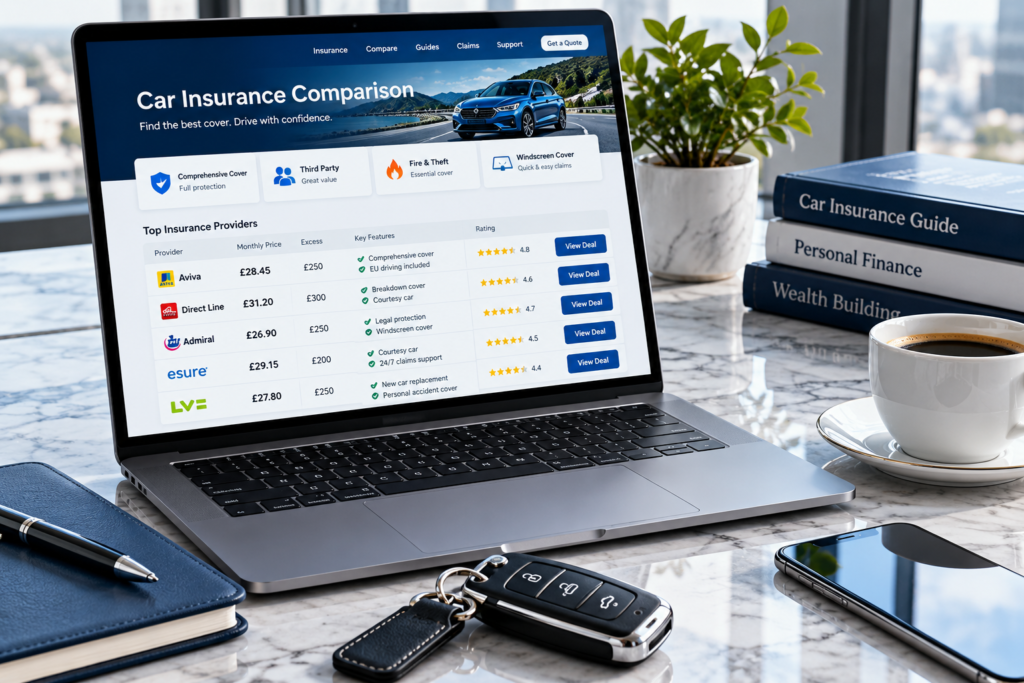
Stop blindly trusting aggregator websites. If you want to compare auto insurance quotes without getting scammed by hidden coverage gaps, you need a strict mathematical methodology. Most drivers choose the cheapest monthly premium, completely unaware they just bought a stripped-down policy that will bankrupt them in a severe crash. The secret to beating the algorithm is forcing every carrier to quote the exact same limits. Here is your insider blueprint for stripping away the marketing noise and securing real financial protection.
The “Apples to Oranges” Pricing Trap
The biggest mistake consumers make is shopping by the final monthly price tag. Company A quotes $80 a month. Company B quotes $120 a month. You pick Company A.
Congratulations. You likely just bought a useless policy.
Company A quoted you state-minimum liability limits. Company B quoted you robust, full-coverage protection. You did not find a better deal; you bought less product. To break this cycle, you must learn to read your Declarations Page (or “Dec Page”). This one-page document sits at the front of your current policy and lists your exact coverages, limits, and deductibles.
When you shop for new insurance, your current Dec Page is your baseline. You must force every new carrier to quote those exact limits. If you currently carry a $500 deductible, do not let an online quoting tool default to a $1,000 deductible just to make their price look unbeatable. Control the variables.
Decoding Bodily Injury Liability (The 100/300/100 Rule)
Liability insurance pays for the damage you cause to other people. It does not cover your car or your injuries. It is the financial firewall standing between a plaintiff’s attorney and your personal assets.
Most states require you to carry liability insurance by law. The limits are written as a series of three numbers, such as 25/50/15. This translates to $25,000 for bodily injury per person, $50,000 for bodily injury per accident, and $15,000 for property damage.
Do not buy state minimums. If you total a new Tesla and put the driver in the ICU, a $15,000 property damage limit and a $25,000 medical limit will be exhausted before the ambulance reaches the hospital. You will be sued personally for the remainder. Your wages will be garnished. Your savings will vanish.
Licensed brokers recommend the 100/300/100 limit structure as the bare minimum for any driver with a steady income or assets to protect.
Table 1: State Minimums vs. Broker Recommended Limits
| Coverage Type | The Legal Minimum Reality (Typical) | What You Should Actually Buy | The Broker’s Reasoning |
| Bodily Injury Per Person | $25,000 | $100,000 | A single surgical ER visit easily exceeds $25k. You are personally liable for the overage. |
| Bodily Injury Per Accident | $50,000 | $300,000 | If you hit a minivan with four passengers, $50k split four ways is catastrophic underinsurance. |
| Property Damage | $15,000 to $25,000 | $100,000 | The average cost of a new car approaches $48,000. Hitting an EV or a multi-car pileup wipes out low limits instantly. |
| Medical Payments (MedPay) | $0 (Often optional) | $5,000 to $10,000 | Pays your own medical deductibles immediately, regardless of fault, keeping you out of collections. |
Comprehensive vs. Collision: When to Drop the Weight
Physical damage coverage is split into two distinct categories. Understanding the difference dictates how much you pay.
Collision coverage pays to fix your vehicle when you hit another car or a stationary object (like a telephone pole). Comprehensive coverage pays for everything else: theft, vandalism, hail, fire, or hitting a deer.
Both carry a deductible. The higher the deductible, the lower the premium.
Here is the industry rule for older vehicles: If your car is paid off, check its Actual Cash Value (ACV) using Kelley Blue Book or NADA. If your annual cost for comprehensive and collision exceeds 10% of the vehicle’s ACV, drop them. You are paying mathematically unfavorable odds. Insurance pays out the depreciated ACV, not the replacement cost. If you total a 2012 Honda Civic worth $4,000, and you carry a $1,000 deductible, the absolute maximum payout you receive is $3,000. Stop paying premium prices for depreciating steel.
Uninsured Motorist Coverage: Defending Against the Masses
Roughly 1 in 8 drivers on US roads are completely uninsured. Millions more carry the dangerously low state minimums discussed above.
If an uninsured driver runs a red light and shatters your femur, you cannot sue them for money they do not have. This is where Uninsured Motorist (UM) and Underinsured Motorist (UIM) coverage step in.
Your UM limits should exactly mirror your Bodily Injury limits (100/300). This ensures that if the at-fault driver has no money, your own policy steps in to pay your medical bills, lost wages, and pain and suffering up to $100,000 per person and $300,000 per accident. Never waive UM coverage. It is the cheapest, most vital medical safety net in your policy.
How to Compare Auto Insurance Quotes: The Execution Strategy
Do not rely on lead-generation websites that sell your data to twenty different local agents who will blow up your phone for six months. Run the comparison yourself using a strict workflow.
You need quotes from three distinct channels:
- Direct Writers: Companies like Geico or Progressive that sell directly to consumers. They often have low overhead and cheap rates for clean driving records.
- Captive Agents: Think State Farm, Allstate, or Farmers. You deal with a local agent who only sells that specific brand. Great for bundling complex home and auto policies.
- Independent Brokers: These agents represent 15 to 30 different regional carriers (like Travelers, Safeco, or Erie) that you cannot access on your own.
Table 2: The Quote Comparison Checklist (Apples-to-Apples Worksheet)
Print this out. Fill it in as you speak to agents or use online portals. If a field does not match, the quote is invalid.
| Coverage Metric | Your Current Dec Page | Direct Writer Quote (e.g., Geico) | Independent Broker Quote |
| Bodily Injury Limits | 100/300 | [Enter amount] | [Enter amount] |
| Property Damage Limits | 100k | [Enter amount] | [Enter amount] |
| Uninsured Motorist (UM) | 100/300 | [Enter amount] | [Enter amount] |
| Collision Deductible | $500 | [Enter amount] | [Enter amount] |
| Comprehensive Deductible | $500 | [Enter amount] | [Enter amount] |
| Rental Car Reimbursement | $30/day | [Enter amount] | [Enter amount] |
| Total 6-Month Premium | $XXX | $XXX | $XXX |
The Dark Side of Telematics (Drive-Safe Apps)
Every major carrier is pushing “telematics”—smartphone apps or OBD2 plug-in devices that track your driving behavior. They lure you in with promises of a “30% safe driving discount.”
Here is the raw truth the marketing departments hide: It is not just a discount tool. It is an underwriting surveillance program.
While safe drivers can genuinely save money, the algorithms are merciless. Telematics programs track hard braking, rapid acceleration, cornering speed, and time of day.
Do you work the night shift? The algorithm views driving between midnight and 4:00 AM as a massive statistical risk. You will be penalized.
Do you drive in heavy, stop-and-go commuter traffic? The app will record constant hard braking as aggressive driving, completely ignoring the context of urban gridlock.
In many states, if your score is poor, the carrier can legally increase your premium at renewal. If you have a chaotic commute or work irregular hours, reject the telematics discount. The privacy invasion and potential rate hikes are rarely worth the initial $50 savings.
The Hidden Credit Score Penalty (Worse Than a DUI)
You probably assume your driving record dictates your insurance rate. In reality, your credit history often matters more.
Insurance companies use a proprietary metric called a Credit-Based Insurance Score (CBIS). Actuaries discovered decades ago that individuals with poor credit file more claims than individuals with excellent credit.
The penalty is staggering. In most states, a driver with a flawless driving record but “Poor” credit will pay significantly more for car insurance than a driver with “Excellent” credit who has a recent at-fault accident or even a DUI.
The Exceptions: California, Hawaii, Massachusetts, and Michigan have legally banned insurers from using credit scores to determine auto rates.
If you live outside of those four states and your credit score has recently dropped due to a divorce, medical debt, or job loss, your rates are going to spike at renewal. You must proactively seek out carriers that weigh credit less heavily. Independent agents have quoting software that specifically identifies which carriers are forgiving of low credit tiers.
Binding the Policy and Verifying Financial Strength
Once you find the winning quote on your worksheet, verify the carrier’s financial solvency. An insurance policy is just a piece of paper if the company goes bankrupt during a localized disaster.
Check the carrier’s A.M. Best Rating. A.M. Best acts as a credit rating agency strictly for the insurance industry. Only bind a policy with a carrier rated “A-” (Excellent) or higher.
When you are ready to purchase, buy the policy outright if possible. Paying the 6-month or 12-month premium in full avoids monthly installment fees, which act as a hidden APR. Do not cancel your current insurance until the new policy is fully bound, the first payment has cleared, and you have the new digital ID cards in your inbox. A lapse in coverage lasting even 24 hours will flag you as a high-risk driver and obliterate your new rates.
Make quoting your auto insurance an annual habit. Set a calendar reminder 30 days before your renewal date. Grab your Dec Page, pull a fresh batch of quotes from a direct writer and a local broker, and let the math dictate your loyalty.
Pingback: Commercial Vehicle Insurance Best Explained: Coverage, Costs, and Tips for 2026
Pingback: How to Compare Auto Insurance Quotes Online and Save Money in 2026